
Replacing Murray breakers with equivalent Siemens breakers in load centers.
- Murray Breaker Availability and Replacement Options
- Compatible Breakers for Murray Load Centers
- How to Identify Murray Load Centers
- Common Murray Load Center Breaker Types
- Siemens Replacements for Murray Breaker Applications
- Branch Versus Main Breaker Replacement Requirements
- When Murray Load Centers Need Replacement
- Murray Circuit Breaker Replacement Selection Checklist
- Murray Load Center Breaker Replacement Glossary
- Siemens/Murray Load Center Breaker FAQ
Replacing Murray Breakers?
Get a Breaker QuoteSiemens bought Murray electrical products in the 1990’s. This post will help you replace Murray electrical products with equivalent Siemens breakers and electrical equipment for load centers.
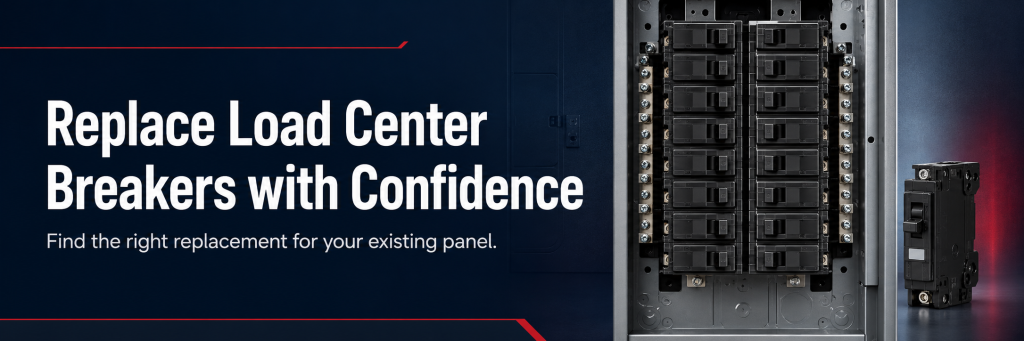
Murray load centers are still in service throughout the United States. Murray-branded electrical equipment is obsolete, but replacing a bad breaker doesn’t require replacing the entire panel.
Finding the right Murray breaker replacement starts with the load-center label. You’ll need to identify breaker types, electrical ratings and panel configuration before selecting a Siemens replacement.
Murray Breaker Availability and Replacement Options
Murray is a legacy electrical product line. Siemens discontinued Murray, and you can identify a comparable Siemens product for residential and industrial light-use applications.
Original Murray load center breakers are available as surplus, used or reconditioned equipment. Availability depends on the breaker family, amperage, number of poles. When selecting an older breaker, check its condition, testing history, warranty and supplier. A Siemens replacement breaker can be used when the panel is in good condition.
Compatible Breakers for Murray Load Centers
When determine breakers compatible with Murray, start with the label inside the load-center door or enclosure. This label identifies breaker types, system voltage, maximum bus rating, main-breaker rating, short-circuit current rating and the maximum number of circuits.
A panel diagram shows acceptable tandem or space-saving breakers. Two breakers may have similar dimensions and bus connections, but physical fit doesn’t mean compatibility. Installing a breaker that isn’t listed, classified or documented for the load center can affect electrical performance and inspection acceptance.
The Siemens Murray-to-Siemens cross-reference gives a starting point. The breaker replacement still needs to be checked against the complete load-center and breaker catalog part numbers.
How to Identify Murray Load Centers
Before removing or ordering a breaker, record the load center’s complete catalog number. Check the inside of the door, enclosure sidewall, dead-front and wiring diagram.
Photograph the complete panel label, existing breaker label, main breaker, bus arrangement and enclosure. Also document discoloration, corrosion, moisture or signs of overheating. The existing breaker label should identify its catalog number, amperage, number of poles, voltage and interrupting rating. It may also identify AFCI, GFCI or other specialized protection.
Common Murray Load Center Breaker Types
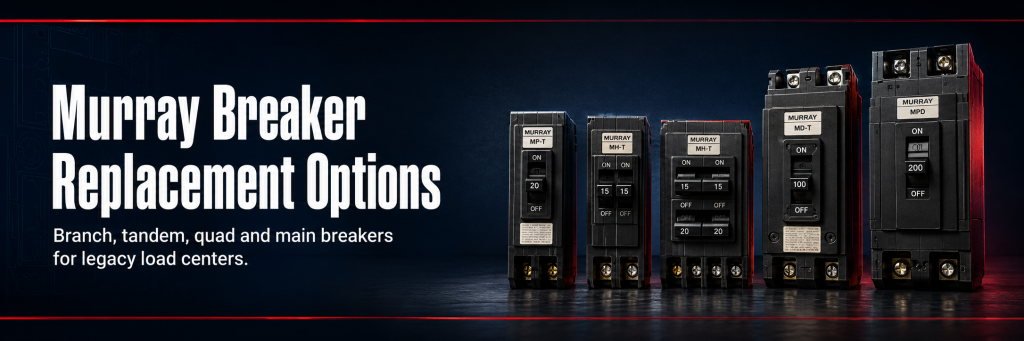
Murray MP-T Branch Breakers
MP-T breakers are full-size plug-in branch breakers used for lighting, receptacle and appliance circuits. They were produced in single-pole and double-pole configurations with various amp ratings. Siemens QP is known as a successor family. See the Siemens QP Breakers Guide for additional information.
Murray MH-T Space-Saving Breakers
MH-T breakers include tandem, duplex and other space-saving configurations. These breakers let multiple circuits use fewer panel spaces, but they can’t be installed in every Murray load center or breaker position.
The panel diagram needs to let the breaker configuration in the selected position. Learn more about this type of equipment in Adding Siemens QT Tandem Breakers to Load Centers. .
Murray AFCI, GFCI and Dual-Function Breakers
Specialized Murray breakers provide arc-fault, ground-fault or combined protection. A replacement should match the needed protection, electrical ratings and neutral-connection design.
Related Siemens replacement breaker information is available in the Siemens QAF AFCI Breakers Guide, Siemens QPF GFCI Breaker Guide and Siemens QFG Dual-Function Breaker Guide
Murray Main Breakers
Legacy Murray main-breaker families include MD-T, MD-TR and MPD. These breakers use panel-specific mounting hardware, lugs and retaining components. A cross-reference for branch breakers can’t be used to select a replacement main breaker.
Siemens Replacements for Murray Breaker Applications
A Siemens replacement for Murray breaker applications are available because Siemens manufactured and supported portions of the Murray residential product line.
| Murray application | Siemens family to investigate | Primary function |
|---|---|---|
| MP-T full-size branch breaker | QP | Standard thermal-magnetic protection |
| MH-T space-saving breaker | QT | Tandem or multi-circuit protection |
| Murray AFCI breaker | QAF | Arc-fault protection |
| Murray GFCI breaker | QPF | Ground-fault protection |
| Murray dual-function breaker | QFG | Combined AFCI and GFCI protection |
| MD-T, MD-TR or MPD main breaker | Application-specific replacement | Main load-center protection |
This table identifies product families to investigate, not automatic replacements. Confirm the exact breaker through the Murray panel label and applicable Siemens documentation.
Murray Circuit Breaker Replacement Chart
Use this Murray circuit breaker replacement chart to match amperage and pole count.
| Murray type | Configuration | Potential successor | Important checks |
|---|---|---|---|
| MP-T | Full-size, 1- or 2-pole | Siemens QP | Panel approval, amps, poles, voltage and AIC |
| MH-T | Tandem, triplex or quad | Siemens QT | Approved positions and maximum circuit count |
| Murray AFCI | Specialized branch breaker | Siemens QAF | AFCI type, neutral design and panel approval |
| Murray GFCI | 1- or 2-pole protection | Siemens QPF | Ground-fault class and neutral arrangement |
| Murray dual-function | Combined protection | Siemens QFG | AFCI/GFCI requirements and neutral design |
| MD-T or MD-TR | Panel-mounted main | Application-specific | Frame, hardware, lugs and panel number |
| MPD | 2-pole main breaker | Application-specific | Amps, voltage, AIC, mounting and bus rating |
Branch Versus Main Breaker Replacement Requirements
Replacing a branch breaker involves matching its breaker family, amperage, poles, voltage, interrupting rating and protection function. The bus stab, breaker clip, terminal and connected conductor need to be checked for heat damage.
Replacing a main breaker involves knowing electrical ratings, so check the load-center catalog number, bus rating, breaker frame, mounting orientation, lug arrangement and retaining hardware.
Main-breaker work also presents greater electrical hazards. Line-side components sometimes remain energized when the main breaker is switched off. Main-breaker inspection and replacement should be handled by a qualified electrical professional.
When Murray Load Centers Need Replacement
A breaker-only repair makes sense when the enclosure, bus and connections remain in good condition and the correct documented replacement is available.
Complete load-center replacement is needed when the bus is burned, pitted or overheated; water or corrosion has entered the enclosure; multiple breakers show heat damage; or the cover and dead-front are missing or damaged. Replacement is practical when main breakers or internal parts are unavailable.
Capacity and modernization requirements matter too. An older Murray panel might not provide enough circuit capacity or flexibility for additional AFCI, GFCI, surge protection, solar, generator or electric-vehicle equipment.
A damaged bus isn’t a breaker-only problem. Installing a new breaker on a deteriorated bus connection can result in continued overheating and another failure.
Murray Circuit Breaker Replacement Selection Checklist
- Before ordering a Murray circuit breaker replacement, confirm the following information:
- Complete load-center catalog number
- Approved breaker types on the panel label
- Existing breaker’s complete catalog number
- Branch-breaker or main-breaker function
- Number of poles and amp rating
- Voltage and interrupting rating
- Full-size or space-saving construction
- AFCI, GFCI or dual-function requirements
- Neutral-connection design
- Condition of the bus, terminals and enclosure
- Manufacturer documentation supporting the replacement
Let the panel label guide the selection. The correct Murray breaker replacement must match the application electrically and mechanically and be documented for use in the existing load center.
Murray Load Center Breaker Replacement Glossary
| Term | Definition |
|---|---|
| AIC | Ampere interrupting capacity, which indicates the maximum fault current a breaker can safely interrupt. |
| AFCI | Arc-fault circuit interrupter protection designed to detect hazardous electrical arcing. |
| Branch breaker | A breaker protecting an individual lighting, receptacle, appliance or equipment circuit. |
| Bus | Conductive metal within a panel that distributes power to installed breakers. |
| Classified breaker | A replacement breaker evaluated for use in specifically identified competing equipment. |
| GFCI | Ground-fault circuit interrupter protection designed to reduce electric-shock hazards. |
| Load center | An enclosure containing the bus, main protection and branch-circuit breakers. |
| Main breaker | The breaker controlling and protecting power supplied to the load-center bus. |
| New-old-stock | Older, unused equipment remaining in inventory after regular production ended. |
| Pigtail neutral | A breaker design with an attached neutral conductor that connects to the panel’s neutral bar. |
| Plug-on neutral | A breaker that connects directly to a compatible neutral rail without a pigtail. |
| Tandem breaker | A space-saving breaker containing two independent single-pole circuits in one breaker position. |