
Siemens QPF GFCI Breaker Selection and Applications

Need Siemens QPF Breakers?

Get Siemens Breaker Quote

Siemens QPF GFCI ground-fault protection

If you’re working on a job involving electricity and water, standard overcurrent protection isn’t enough.
Electrical jobs involving electricity and water

Siemens QPF GFCI residential breakers provide ground-fault protection plus overload and short-circuit protection in normal circuit breakers. This makes an excellent choice for kitchens, bathrooms, garages, outdoor equipment, spas, and other areas where a ground fault means electrical shock.

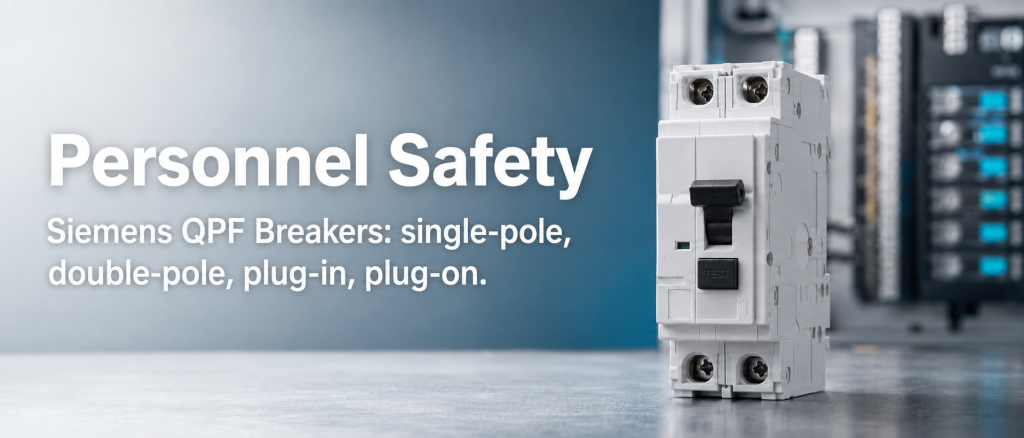
Siemens has multiple QPF-family configurations, including single-pole, double-pole, plug-in, and plug-on-neutral types. Knowing options will help you choose a breaker that’s right for the panel, circuit, and application.

You may also like Siemens QAF AFCI Breakers Guide

What Is a Siemens QPF GFCI Breaker?

Ground-fault circuit interrupter, or GFCI, with a thermal-magnetic circuit breaker

Thermal-magnetic portion protects wiring

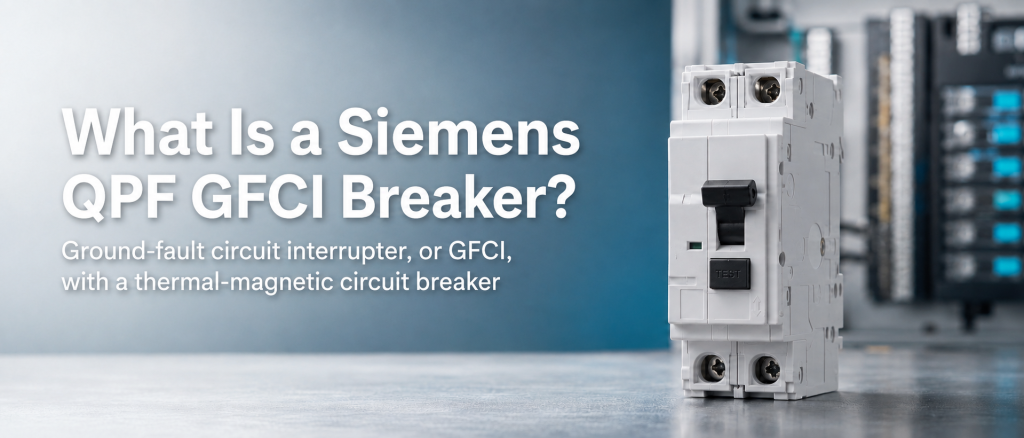
A Siemens QPF breaker is a ground-fault circuit interrupter, or GFCI, with a thermal-magnetic circuit breaker. The thermal-magnetic portion protects wiring against overloads and short circuits. The GFCI portion gives Class A personnel protection by detecting a small difference between the current leaving and returning to the circuit.

That imbalance indicates current is traveling along an unintended path, possibly through damaged equipment, water or a person. The breaker responds by quickly disconnecting power. This is different from equipment ground-fault protection, which may operate at a higher current level. QPF GFCI breakers are designed for personnel safety in residential and lower voltage applications.

How a Siemens GFCI Circuit Breaker Protects You

Continuously compares current flowing through the circuit conductors
When a circuit supplies more than one receptacle

A Siemens GFCI breaker continuously compares current flowing through the circuit conductors. Under normal conditions, the outgoing and returning current should remain balanced. When the breaker detects leakage at approximately the Class A GFCI level, it trips and interrupts the circuit.

This protection is particularly valuable when a circuit supplies more than one receptacle. Installing GFCI protection at the breaker can protect the entire branch circuit instead of relying on individual GFCI receptacles at multiple locations.

Current Siemens GFCI breakers also include self-test functionality. This feature automatically checks the GFCI protection system. But you should still operate the test button regularly. Siemens recommends testing GFCI protection monthly. Learn more from Siemens residential GFCI information.

Siemens QPF vs. QPF2 GFCI Breakers

These designations identify different pole configurations

QPF, QPF2, QPFB and QPF2N designations

You will see QPF, QPF2, QPFB and QPF2N designations while selecting a Siemens QPF2 GFCI breaker. These designations identify different pole configurations, installation styles, interrupting ratings or product generations in the Siemens GFCI family.

Siemens identifies its standard single-pole plug-in GFCI breakers as Type QPF2. Higher-amperage double-pole plug-in models are identified as Type QPF, and some 15- through 30-amp double-pole products use the QPFB designation. QPF2N identifies single-pole plug-on-neutral GFCI breakers.

Don’t select a replacement based only on its physical appearance. Check the panel label, complete breaker catalog number, number of poles, voltage, amperage and interrupting rating. A replacement breaker must be listed or approved for use in that specific load center.

Siemens QPF Breaker Features

Combining several functions in one panel-mounted device

Overload, short-circuit, Class A ground-fault personnel protection

A Siemens ground fault breaker simplifies circuit protection by combining several functions in one panel-mounted device. You get overload protection, short-circuit protection and Class A ground-fault personnel protection without installing a separate GFCI receptacle at every point that requires protection.

Other important features include:

Single-pole and double-pole configurations
Plug-in and plug-on-neutral installation options
Self-test functionality on current models
Test and reset controls at the electrical panel
Standard and higher interrupting ratings
Coverage for the complete protected branch circuit

Plug-on-neutral models can also reduce panel wiring because the breaker connects directly to the load center’s neutral bar. This feature only applies when the breaker is installed in a compatible Siemens plug-on-neutral load center.

Examples from Siemens’ GFCI selection.

Catalog numberTypePolesAmpsVoltageInterrupting rating
QF115ACSAQPF2 plug-in115A120V AC10 kA
QF120ACSAQPF2 plug-in120A120V AC10 kA
QF130ACSAQPF2 plug-in130A120V AC10 kA
Q215GFCSAQPFB plug-in215A120/240V AC10 kA
Q220GFCSAQPFB plug-in220A120/240V AC10 kA
Q230GFCSAQPFB plug-in230A120/240V AC10 kA
QF240ACSAQPF plug-in240A120/240V AC10 kA
QF250ACSAQPF plug-in250A120/240V AC10 kA
QF260ACSAQPF plug-in260A120/240V AC10 kA
QF120ANCSAQPF2N plug-on neutral120A120V AC10 kA

Siemens also lists higher-interrupting QPHF and HQPF configurations for certain ratings. Review the Siemens GFCI selection sheet for current configurations.

Catalog numberTypePolesAmpsVoltageInterrupting rating
QF115QPF2 GFCI, plug-in115A120V AC10 kA
QF120QPF2 GFCI, plug-in120A120V AC10 kA
QF130QPF GFCI, plug-in130A120V AC10 kA
QF215QPF GFCI, plug-in215A120/240V AC10 kA
QF220QPF GFCI, plug-in220A120/240V AC10 kA
QF230QPF GFCI, plug-in230A120/240V AC10 kA
QF240QPF GFCI, plug-in240A120/240V AC10 kA
QF250QPF GFCI, plug-in250A120/240V AC10 kA
QF260QPF GFCI, plug-in260A120/240V AC10 kA
QF120AQPF2 self-testing GFCI, plug-in120A120V AC10 kA

These are Class A GFCI breakers with 5 mA ground-fault sensitivity listed for sale at relectric.com. Always verify the breaker and Siemens load-center compatibility before selecting a replacement.

Applications for Siemens Ground Fault Breakers

Circuits serving bathrooms, kitchens, garages, basements, laundry areas and outdoor receptacles.

Know Conductor size, voltage, number of poles

Siemens QPF GFCI breakers are used for circuits serving bathrooms, kitchens, garages, basements, laundry areas and outdoor receptacles. Double-pole versions can be used with spas, hot tubs and other 240-volt equipment when the equipment specifications and applicable electrical code require GFCI protection.

The correct breaker depends on more than the equipment’s operating amperage. You’ll need to look at conductor size, voltage, number of poles, neutral requirements and load-center compatibility. Local code requirements can change, so consider code and equipment instructions for your circuit protection.

Selecting Siemens QPF GFCI Breaker

Start by reading the load-center label.

Follow the wiring diagram supplied with the breaker

Rading the load-center label identifies the breaker types approved for the panel. Next, record the complete catalog number of the existing breaker and compare it with Siemens’ current selection information.

Match the replacement breaker’s amperage to the circuit conductors and connected load. Confirm whether you need a single-pole 120-volt breaker or a double-pole 120/240-volt breaker. You should also verify the available fault current and required interrupting rating.

Neutral wiring is important. Some 240-volt loads don’t use a load neutral, but the breaker may still require its coiled neutral or panel-neutral connection for the GFCI electronics to operate. Follow the wiring diagram supplied with the breaker.

Testing and Troubleshooting

Test monthly according to Siemens’ recommendation.

Confirm breaker opens the protected circuit

After installation, use the test button to confirm the breaker opens the protected circuit. Test monthly according to Siemens’ recommendation.

If the breaker repeatedly trips, don’t assume it’s defective. Moisture, damaged insulation, a failing appliance, incorrect neutral wiring or a downstream neutral-to-ground connection can all cause tripping. Disconnecting loads individually may help identify the equipment, but troubleshooting inside the panel should be handled by a qualified electrician.

Never replace a tripping GFCI breaker with a standard breaker just to keep the circuit energized. That will remove personnel protection without correcting the problem.

What is a Siemens QPF breaker? +
A Siemens QPF breaker is a Ground Fault Circuit Interrupter breaker that provides overload, short-circuit, and Class A ground-fault protection. It disconnects the circuit when it detects current leaking outside its intended path.
What does GFCI protection do? +
GFCI protection monitors the current flowing through a circuit. If the breaker detects an imbalance that could indicate current leaking to ground, it quickly shuts off power to help reduce the risk of electrical shock.
Where are Siemens QPF breakers commonly installed? +
Siemens QPF breakers are commonly used for circuits serving kitchens, bathrooms, garages, laundry areas, outdoor equipment, swimming pools, spas, hot tubs, and other locations where electrical equipment may be exposed to moisture.
What is the difference between Siemens QPF and QAF breakers? +
Siemens QPF breakers detect ground faults and help protect people from electrical shock. Siemens QAF breakers detect hazardous arc faults that can damage wiring and cause electrical fires.
What is the difference between Siemens QPF and QP breakers? +
A standard Siemens QP breaker provides overload and short-circuit protection. A QPF breaker provides those protections while also monitoring the circuit for ground-fault leakage.
What amperages are available for Siemens QPF breakers? +
Common Siemens QPF breakers include single-pole 15-, 20-, and 30-amp models and two-pole models ranging from 15 through 60 amps. The correct amperage must match the circuit conductors, connected load, and panel requirements.
What does the TEST button on a Siemens QPF breaker do? +
The TEST button creates a simulated ground-fault condition to confirm that the breaker can trip properly. Follow Siemens instructions for testing frequency and replace or inspect a breaker that does not respond correctly.
Why does my Siemens QPF breaker keep tripping? +
Repeated tripping may indicate a ground fault, damaged wiring, moisture, a defective appliance, an overload, or another circuit problem. Frequent tripping does not automatically mean the breaker has failed. The circuit should be inspected to identify the cause.
Can I install a Siemens QPF breaker in any electrical panel? +
No. The breaker must be listed or approved for the specific load center. Check the panel label, breaker catalog number, electrical ratings, and Siemens compatibility information before installing a replacement.

What to Know About QPF Breakers

Term Definition
GFCI Ground Fault Circuit Interrupter protection designed to disconnect power when electrical current leaks outside its intended path.
Ground fault An unintended electrical path between an energized conductor and ground, equipment, or a person.
Class A GFCI Personnel-protection GFCI equipment designed to trip when ground-fault leakage reaches approximately 5 milliamps.
QPF A Siemens breaker family that combines thermal-magnetic circuit protection with ground-fault protection.
QPF2 A newer Siemens QPF GFCI breaker design commonly available with automatic self-testing capabilities.
Trip sensitivity The amount of ground-fault leakage that causes the protective device to disconnect the circuit. Class A GFCI breakers typically use a 5 mA rating.
Thermal-magnetic protection Breaker protection that uses a thermal response for sustained overloads and a magnetic response for short circuits.
Interrupting rating The maximum fault current a breaker can safely interrupt under specified conditions. Many Siemens QPF breakers have a 10 kA rating.
Plug-in breaker A breaker that connects to the load center bus without requiring a bolted electrical connection.
Plug-on neutral A breaker design that connects directly to the panel’s neutral bar, reducing or eliminating the need for a separate neutral pigtail.
Load center An electrical panel that contains circuit breakers and distributes power to individual branch circuits.
TEST button A breaker control used to simulate a fault and confirm that the GFCI mechanism can disconnect the circuit.
Self-test An automatic monitoring feature that regularly checks whether the breaker’s ground-fault protection is functioning.
UL listed Indicates that the product has been evaluated and certified to applicable safety standards by Underwriters Laboratories.