
Siemens QT breakers are a good choice for adding circuits without replacing an existing load center.
Need Siemens QT Breakers?
Get Siemens Breaker Quote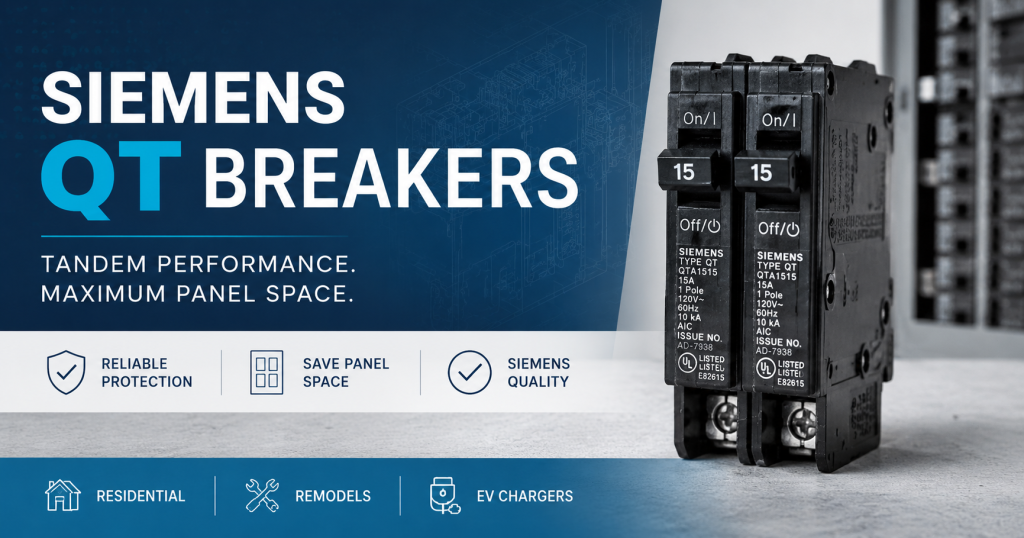
Adding Siemens QT Tandem Breakers to Load Centers
Siemens QT breakers install like standard residential breakers and provide thermal-magnetic protection for branch circuits.
One of the main reasons that builders and homeowners use Siemens QT Tandem molded case breakers is their flexibility to add circuits without replacing an existing load center. Many residences run out of panel space before the electricity utility does. A tandem breaker can sometimes resolve the issue without the need to install a larger panel or add a subpanel.
Siemens QT breakers are popular during remodeling projects. When you’re finishing a basement, updating a kitchen, adding a home office, or installing new appliances, you may need several additional circuits. Rather than replacing the panel, an approved tandem breaker can create room for those circuits while maintaining compliance with the panel’s design limitations.
Typical Applications for QT Tandem Breakers
Siemens QT tandem breakers are often used when homeowners need additional circuits but have limited panel space.
Homeowners that install workshops, garages, electric vehicle chargers, or home office equipment usually meet panel space limits. In many of these cases, tandem breakers are an affordable alternative providing a way for additional circuits without having a more significant electrical overhaul.
Dedicated appliance circuits for microwaves, dishwashers, disposals, and countertop receptacles are usually needed during kitchen remodels.
How to Determine Panel Compatibility
The most important step to take before getting a tandem breaker is to make sure that your panel is approved for its use.
Siemens’ panel marking inside the load center door indicates acceptable breaker types and approved tandem placements.
Modern load centers use Circuit Total Limitation (CTL) designs to prevent excessive circuit additions. These designs help homeowners stay within the panel’s intended circuit capacity. Installing tandem breakers on a panel that was not built for them can lead to safety, code compliance, and inspection problems.
When in doubt, look for the panel documentation or call a skilled electrician. A few minutes of verification will help you avoid costly mistakes and keep your installation compliant.
Understanding CTL and Non-CTL Siemens QT Breakers
CTL stands for Circuit Total Limitation, a design standard intended to prevent electrical panels from exceeding their approved circuit capacity.
Most modern residential load centers use CTL breakers and designated tandem breaker positions. Non-CTL breakers are used as replacement devices in certain older panels where tandem breakers were previously installed. Before purchasing either type, verify the panel model number and manufacturer recommendations for proper compatibility.
Understanding the difference between CTL and Non-CTL breakers helps prevent installation issues and adds compliance with electrical codes and inspection requirements.
Common Siemens QT Breaker Models
| Part Number | Description | Typical Application |
| QT1515 | 15A / 15A Tandem Breaker | Lighting Circuits |
| QT2020 | 20A / 20A Tandem Breaker | General Receptacles |
| QT151520 | 15A / 20A Tandem Breaker | Mixed Circuit Loads |
| QT202030 | 20A / 30A Tandem Breaker | Dedicated Equipment |
| QT3030 | 30A / 30A Tandem Breaker | Specialty Loads |
| QT1515NC | Non-CTL Tandem Breaker | Older Panels |
| QT2020NC | Non-CTL Tandem Breaker | Replacement Applications |
| QT151520NC | Non-CTL Mixed Rating Breaker | Legacy Equipment |
| QT2020H | High Interrupting Tandem Breaker | Higher Fault Current Applications |
| QT1515H | High Interrupting Tandem Breaker | Residential Service Equipment |
Relectric has a broad inventory of new, older, and hard to find Siemens Breakers. Get detailed specs and design information on hundreds of new and surplus breakers certified to your specifications.
Siemens QT Breakers for Residential Panel Upgrades
Residential electrical systems today support more devices than they did just a few decades ago.
Large televisions, computers, gaming systems, smart home technology, electric vehicle chargers, and modern kitchen appliances all add demands on a home’s electrical distribution system.
So many homeowners discover they need more circuits than their existing panel layout can support. Siemens QT tandem breakers provide a practical solution in approved load centers by letting two circuits occupy a single breaker space. While tandem breakers don’t increase the overall electrical capacity of the service, they maximize available panel space and delay a more extensive electrical upgrade.
Siemens QT Tandem Breaker Glossary
| Term | Definition |
|---|---|
| Tandem Breaker | A circuit breaker that provides two independent circuits within a single breaker space. |
| Duplex Breaker | Another common term for a tandem breaker. |
| CTL | Circuit Total Limitation. A design feature that controls where tandem breakers may be installed. |
| Load Center | A residential electrical distribution panel that houses branch circuit breakers. |
| Branch Circuit | The wiring and overcurrent protection serving lighting, receptacles, or equipment. |
| Bus Bar | The energized conductor inside a panel that supplies power to circuit breakers. |
| Thermal-Magnetic Trip | A breaker trip mechanism that responds to both overloads and short circuits. |
| Interrupting Rating | The maximum fault current a breaker can safely interrupt. |
| Non-CTL Breaker | A tandem breaker typically used in approved replacement applications for older panels. |