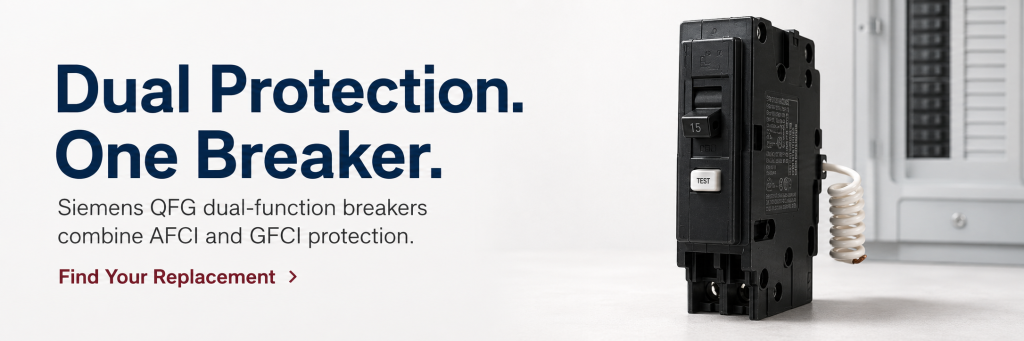
Installing separate devices is not the only choice when a branch circuit needs protection from ground-fault current and dangerous arcing.
Dual Function Breaker Simplifies circuit protection
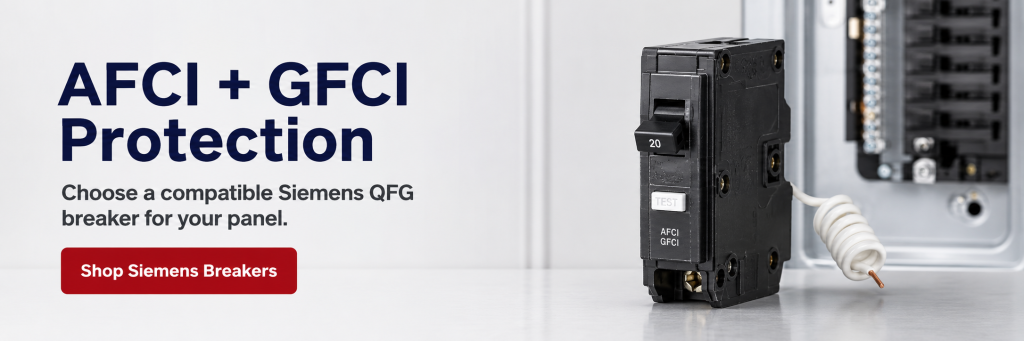
Siemens QFG dual-function breakers are panel-mounted devices that combine Class A ground-fault circuit interrupter protection with combination-type arc-fault circuit interrupter protection. Using a single breaker location gives you two different safety features.
That combination simplifies circuit protection, testing and troubleshooting. The breaker still needs to be compatible with the panel, circuit rating, and neutral-connection design, though. Read further to learn how these Siemens replacement breakers function, how Siemens detects them, and choosing a replacement breaker.
What Is a Siemens QFG Breaker?
A Siemens dual-function circuit breaker protects a branch circuit against overloads and short circuits while monitoring for arc faults and Class A ground faults.
Combines the jobs of a standard thermal-magnetic breaker
It combines the jobs of a standard thermal-magnetic breaker, a combination-type AFCI and a GFCI in one device.
The terminology can be confusing. QFG is used as a family or search term, but Siemens literature describes the products as dual-function AFCI/GFCI breakers. QFGA2 is a formal breaker type, while Q115DF and Q120DF are familiar catalog numbers.
Dual function doesn’t mean double pole, two circuits or tandem construction. Residential breaker models are single-pole, 120-volt breakers protecting one branch circuit. “Dual” refers to combining AFCI and GFCI protection.
How AFCI and GFCI Protection Work
GFCI prevents electrical shock by cutting power when current leaks to an unintended path. AFCI prevents electrical fires by cutting power when it detects dangerous sparking (arcing) in damaged wiring.
AFCI vs. GFCI: How They Protect You From Fire and Shock
AFCI Protection An electrical discharge that has a chance to produce extreme heat is called an arc fault. It might look at a crushed cable, deteriorating cord, loose connection, or damaged conductor. Some arc faults do not immediately draw enough current to activate a traditional breaker. When it detects a risk, a combination-type AFCI disconnects the circuit after keeping an eye out for electrical patterns with parallel and series arcing.
GFCI Protection Current leaving on the ungrounded conductor and current returning on the neutral conductor are compared by a GFCI. A discrepancy could indicate that current is leaving through an unwanted route. To prevent electric shock, a Class A GFCI reacts at a low ground-fault threshold.
Two Different Functions in One Breaker A GFCI contrasts the current flowing out of the ungrounded wire with the current flowing back into the neutral conductor. A discrepancy may be a sign that current is escaping via an unexpected route. Class A GFCIground fault protection keeps you from electric shock by reacting at a low ground-fault level.
Why Use a Siemens Combination AFCI GFCI Breaker?
An AFCI breaker combined with a downstream GFCI outlet can be replaced by a single dual-function breaker when both protection features are needed.
One protective device instead of coordinating devices
The installation uses one protective device instead of coordinating two different devices, and you can test and reset the protection at the load center.
Self-testing is included in Siemens dual-function devices. The lockout design is designed to prevent normal resetting when protection has been weakened, and the devices verify protective functions. To focus the search for an arc fault, ground fault, overload, or short circuit, diagnostic LEDs determine the last known trip state.
Pigtail vs. Siemens Plug-On-Neutral Dual-Function
Both Pigtail and Plug-On-Neutral (PoN) Siemens dual-function breakers protect against both arc faults and ground faults. The difference lies in the neutral connection.
Siemens Dual-Function Breakers: Pigtail vs. Plug-On-Neutral
Conventional pigtail types are connected to the neutral bar of the load center by a coiled white neutral lead. The breaker is where the branch-circuit neutral ends. Siemens load centers that accept the specified QFGA2 breaker type are compatible with this design.
Plug-on-neutral models attach straight to a suitable Siemens plug-on-neutral load center’s neutral rail. Wire-bending space can be increased and neutral-bar wiring can be decreased by removing the pigtail. The breaker is not universal as a result. In a panel intended and labeled for that connection, a plug-on-neutral breaker is required.
Physical fit isn’t enough to confirm compatibility. Before selecting either design, read the load-center label and verify the listed breaker type, neutral arrangement, voltage, pole count, amperage and interrupting rating.
Common Siemens QFG Models and Specifications
This table summarizes four common models. Catalog availability and suffixes can vary by market and packaging, so confirm the complete number printed on the breaker and panel documentation before ordering.
The Siemens Q115DF breaker is a 15-amp, single-pole pigtail model, and the Siemens Q120DF breaker is its common 20-amp. If you’re comparing Q115DF vs Q120DF, the primary difference is the ampere rating — not the protective technology. The circuit conductor size and intended load must support the rating.
Typical Q115DF and Q120DF specs identify 120-volt operation, a 10 kA interrupting rating and conductor ranges of No. 14 through No. 8 AWG copper or No. 12 through No. 8 AWG aluminum. Always use the markings and instructions for the exact breaker because higher-interrupting and bolt-on variations can have different catalog numbers and applications.
Where Siemens Dual-Function Breakers Are Used
Dual-function breakers work well in residential branch circuits in locations where both AFCI and GFCI protection apply.
New construction, remodeling and replacement work
Examples may include kitchens, laundry areas and other circuits covered by local electrical code. These breakers are good in new construction, remodeling and replacement work when the load center is compatible.
Code requirements change by edition and jurisdiction. A product description referring to an older National Electrical Code edition doesn’t determine what your current local code authority calls for. An electrician should evaluate the circuit, application and locally adopted rules.
How to Select the Correct Breaker
Start with the load-center label. See that the panel lists the applicable Siemens breaker type, then match the circuit’s amperage, voltage, pole count and required interrupting rating.
Selecting the Correct Siemens Dual-Function Replacement Breaker
Confirm if the panel uses a pigtail-neutral or plug-on-neutral electronic breaker. Don’t select a breaker because its housing fits the bus connection.
Note the complete catalog number and photograph the breaker and panel label before removing anything. A 15-amp breaker shouldn’t be replaced with a 20-amp breaker unless a qualified person has verified the conductors, circuit and connected equipment are correctly rated.
Also, replacing a dual-function breaker with an AFCI-only, GFCI-only or standard breaker may remove required protection.
Siemens AFCI GFCI Troubleshooting
Follow the manufacturer’s testing instructions and use the breaker’s TEST button at the recommended interval.
Testing, Resetting and Siemens AFCI GFCI Troubleshooting
To reset a tripped breaker, the handle usually needs to be moved fully to OFF before returning it to ON. If the breaker won’t reset, don’t force it or repeatedly cycle it.
A trip can be caused by overload, short circuit, ground leakage, hazardous arcing, damaged wiring, loose connections, a faulty appliance, an incorrectly connected neutral or downstream neutral-to-ground contact. Siemens diagnostic
Circuit breakers should be installed by qualified electrical personnel. Turn off and lock out the power supplying the equipment before work begins, and verify there’s no voltage using test equipment.
Finding Siemens QFG Replacement Breakers
Use the catalog number, ampere rating, panel model and neutral design together when requesting a quote. Relectric supplies new, older and hard-to-find Siemens circuit breakers and can help you identify a replacement matching your specs.
A Siemens QFG dual-function breaker combines combination-type AFCI protection, Class A GFCI protection, and standard overload and short-circuit protection in one panel-mounted device. It helps protect a compatible branch circuit from hazardous arcing, ground-fault current, overloads, and short circuits.
Is a dual-function breaker the same as a two-pole breaker?
No. Dual-function refers to the combination of AFCI and GFCI protection. Common Siemens Q115DF and Q120DF breakers are single-pole, 120-volt devices protecting one branch circuit. A two-pole breaker connects to two bus poles and serves a different purpose.
What is the difference between QFG, QFGA2, and Q115DF?
QFG is commonly used as a family or search term for Siemens dual-function breakers. QFGA2 is the breaker type associated with common pigtail dual-function AFCI/GFCI breakers. Q115DF is a specific 15-amp, single-pole catalog number within that product group.
How do Siemens QFG, QAF, and QPF breakers differ?
Siemens QFG dual-function breakers provide both AFCI and GFCI protection. Siemens QAF breakers provide combination-type AFCI protection, while Siemens QPF breakers provide GFCI protection. These breaker families are not automatically interchangeable, even when they appear similar.
Can a plug-on-neutral breaker replace a pigtail breaker?
Only if the load center is specifically designed and listed for the plug-on-neutral breaker type. A plug-on-neutral breaker is not a universal replacement for a pigtail model. Confirm the panel label, breaker type, amperage, voltage, and neutral arrangement before making a replacement.
Why does my Siemens dual-function breaker keep tripping?
Repeated tripping can indicate a genuine arc fault, ground leakage, overload, short circuit, damaged appliance, loose wiring, incorrect neutral connection, or downstream neutral-to-ground contact. Record the LED indication and operating conditions, then have a qualified electrician investigate the circuit.
How often should a Siemens dual-function breaker be tested?
Follow the testing interval and method printed on the breaker and in current Siemens instructions. Self-testing monitors internal protective functions, but it does not eliminate the need to use the TEST button as directed by the manufacturer.
Term
Definition
AFCI
Arc-fault circuit interrupter. A protective device that monitors for electrical patterns associated with hazardous arcing.
GFCI
Ground-fault circuit interrupter. A device that detects an imbalance between outgoing and returning current and disconnects the circuit.
Dual-function breaker
A circuit breaker combining AFCI and Class A GFCI protection with overload and short-circuit protection.
Combination-type AFCI
An AFCI intended to provide protection against both series and parallel arc-fault conditions within its listed capabilities.
Class A GFCI
Ground-fault protection designed for personnel protection at a low current-imbalance threshold, commonly described as 5 mA protection.
QFGA2
A Siemens breaker type associated with common single-pole pigtail dual-function AFCI/GFCI breakers.
Plug-on neutral
A breaker connection that engages a compatible panel neutral rail directly instead of using a neutral pigtail.
Pigtail neutral
A factory-attached neutral lead that connects the electronic breaker to the load center’s neutral bar.
Interrupting rating
The maximum available fault current a breaker is rated to interrupt safely under specified conditions.