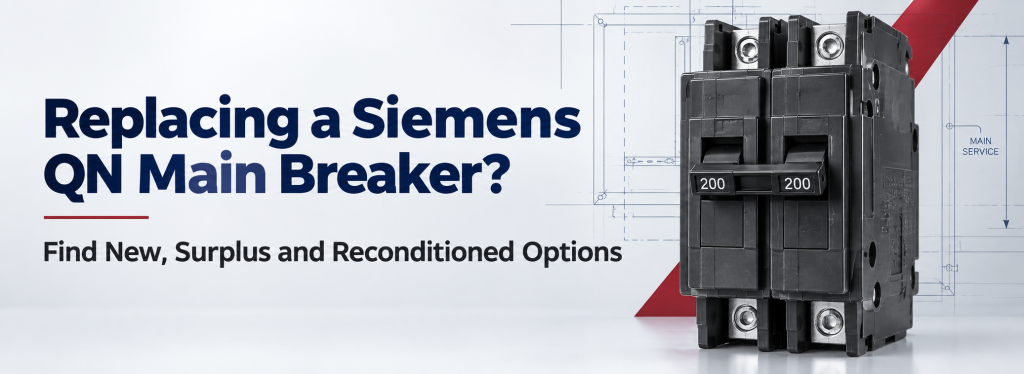
QN Plug-In Main Breakers Replacement Guide

Need a Siemens QN Main Breaker?

Get a Breaker Quote

Siemens QN Main Breakers

Siemens QN Plug-In Main Breakers Replacement Guide

Siemens QN circuit breaker is a high-amperage, two-pole breaker. They have a plug-in mounting design as a main or feeder in compatible Siemens electrical equipment. QN breakers aren’t to be confused with Siemens plug-on-neutral AFCI, GFCI, or dual-function branch breakers.When you’re looking for a replacement, “plug-in” or “plug-on” refers to how a breaker activates the bus.

Siemens QN Breaker Basics

What Is a Siemens QN Circuit Breaker?

Siemens Type QN breakers are thermal-magnetic circuit breakers are used in 120/240-volt load centers, meter combinations and related residential or light-commercial distribution equipment. You’ll get overload and short-circuit protection for higher-amperage circuits.

Unlike standard Siemens QP branch breaker, QN breakers go into four one-inch panel spaces. Its larger construction supports applications like a service main, panel main or high-capacity feeder.

For example is the Siemens QN2150. This model is a two-pole, 150-amp, 120/240-volt breaker with a 10 kA interrupting rating. It has the basic QN configuration, but you’ll need to confirm the requirements of your electrical equipment before ordering a replacement breaker.

Review the Siemens and ITE circuit breaker catalog to compare QN breakers with other Siemens breaker families.

Plug-In vs. Bolt-On

Is a Siemens QN Breaker Plug-In, Plug-On or Bolt-On?

The terms plug-in and plug-on are used interchangeably in the electrical industry. Both describe a breaker with phase connections engaging the panel bus through pressure contacts instead of a bolted electrical connection.

But neither term automatically means bolt-on. A true bolt-on breaker has its electrical connection to the phase bus secured with bolts.

A Siemens Type QN breaker works as a plug-in main or feeder breaker. It can use a screw, retainer or other hardware to secure it inside the equipment, but that hardware doesn’t make it a bolt-on breaker. A retaining device can hold a plug-in breaker in place without being the breaker’s electrical connection to the bus.

Also, Siemens refers to neutral-connection as “Plug-On Neutral.” A plug-on-neutral electronic breaker does away with the neutral pigtail seen on many AFCI, GFCI, and dual-function breakers by connecting directly to a panel neutral rail.

QN vs. Plug-On Neutral

Siemens QN vs. Plug-On-Neutral Breakers

A Siemens QN main breaker doesn’t use the direct neutral-rail connection associated with a plug-on-neutral AFCI, GFCI or dual-function breaker. The QN breaker connects to ungrounded conductors and provides overcurrent protection for the 120/240-volt electrical service or feeder.

A Siemens plug-on-neutral electronic breaker serves a different purpose. It generally protects an individual branch circuit with arc-fault, ground-fault or combined protection.

For example, Siemens QPF GFCI breakers provide ground-fault personnel protection plus overload and short-circuit protection. Plug-on-neutral models are available for compatible Siemens load centers.

Siemens QFG dual-function breakers combine AFCI and GFCI protection in one branch-circuit breaker. These electronic breaker families shouldn’t be confused with Type QN main breakers or treated as interchangeable with them.

Common QN Applications

Where Siemens QN Main Breakers Are Used

You’ll see QN breakers installed in compatible Siemens load centers, meter-load-center combinations and multifamily metering equipment. Depending on the equipment design, the breaker may serve as the service main, panel main or a high-amperage feeder supplying another distribution panel.

Two breakers may attach in a similar way while having different ratings, mounting requirements or approved applications, so start by reading the equipment label. It should identify the approved breaker types and show the maximum main-breaker rating, acceptable mounting positions and retaining hardware you’ll need.

The Murray load center breaker replacement guide explains why you must verify the panel label and complete catalog number instead of assuming that every physically similar Siemens or Murray breaker is interchangeable.

QN Catalog Numbers

Understanding Siemens QN Catalog Numbers

Common examples include:

  • QN2150, commonly associated with a two-pole, 150-amp QN breaker
  • QN2175, commonly associated with a two-pole, 175-amp QN breaker
  • QN2200, commonly associated with a two-pole, 200-amp QN breaker

Suffixes indicate differences involving interrupting capacity, mounting orientation or construction. A QN, QNH and QNR product can share the same amperage while having important application differences.

Part NumberShort Description
QN2150Standard QN, 150A, 2-pole, 120/240V, 10 kA, plug-in breaker
QN2175Standard QN, 175A, 2-pole molded-case breaker
QN2150HQN high-interrupting model, 150A, 2-pole, 120/240V, 22 kA
QN2175RQNR configuration, 175A, 2-pole, 120/240V, 10 kA
QN2200RQNR configuration, 200A, 2-pole, 120/240V, 10 kA
These are examples only. The complete catalog number, panel listing, mounting orientation, interrupting rating and retaining hardware must be verified before selecting a replacement. The specifications above come directly from the corresponding Relectric product listings, including QN2150, QN2150H, QN2175R and QN2200R

Ratings and Variations

Siemens QN Breaker Ratings and Variations

Standard QN models are 10 kA interrupting rating at 240 volts. Higher-interrupting versions use a different designation or suffix. The replacement breaker’s interrupting rating must be compatible for the available fault current at the installation.

Typical QN-family characteristics can include:

  • Two-pole construction
  • 120/240-volt operation
  • Thermal-magnetic protection
  • Plug-in phase connections
  • High-amperage main or feeder applications
  • Standard or higher interrupting capacities

Don’t assume that a higher interrupting rating makes a breaker an acceptable replacement. The equipment listing, breaker type, mounting details and manufacturer instructions are the determining factors.

Relectric’s overview of the different types of circuit breakers provides additional information about breaker construction and protection.

Selecting a Replacement

How to Select a Siemens QN Breaker Replacement

A Siemens QN breaker replacement should be selected from the complete equipment and breaker information, not just the handle rating.

First, photograph the panel label and existing breaker before anything is removed. Record the complete breaker catalog number, equipment model, amperage, voltage, number of poles and interrupting rating.

Next, verify the breaker’s function. Will it be the service main, equipment main or feeder breaker? Check conductor size, conductor material and terminal requirements against the markings on the replacement breaker.

You should also verify:

  • The breaker type is listed for the equipment.
  • The amperage matches the protected conductors and equipment rating.
  • The voltage and number of poles are correct.
  • The interrupting rating is sufficient.
  • The mounting orientation and bus connection match.
  • Required retainers, hold-down hardware or main-breaker kits are present.

Physical fit doesn’t determine electrical or listing compatibility. If the panel label can’t be read, use the equipment model and clear photographs to request identification assistance.

Inspection and Troubleshooting

Inspecting and Troubleshooting Siemens QN Breakers

Main breakers carry a lot of current, so the condition of the electrical connections is important. Discoloration, melted insulation, damaged bus connections, unusual odors or heat marks mean loose connections, overloads or deterioration.

A breaker that trips repeatedly shouldn’t necessarily be replaced with a higher-amperage model. Tripping may result from an overload, short circuit, conductor problem, damaged equipment or a failing breaker. Increasing the breaker rating without evaluating the circuit can remove necessary conductor protection.

Relectric’s discussion of common circuit breaker problems helps you recognize conditions needing further research.

Work on a main breaker involves energized conductors even when the breaker handle is off. Inspection, testing and replacement should be performed by qualified electrical personnel after lockout, voltage-verification and electrical-safety procedures.

Finding QN Breakers

Finding Siemens QN Replacement Breakers

Older installations may require a QN breaker that isn’t available through standard distribution channels. Depending on the catalog number, your options include factory-new, new-surplus or professionally reconditioned equipment.

Relectric supplies new and hard-to-find Siemens and ITE circuit breakers. When requesting a replacement, provide the complete catalog number, panel information, breaker photographs and electrical ratings.

This information differentiates a QN model from QNH, QNR and other configurations. If the exact breaker is unavailable, a technical specialist can help identify an approved replacement.

Request a QN Breaker

Need a Siemens QN Main Breaker?

Use the complete catalog number, panel model and electrical ratings to locate the correct breaker. Relectric can help you source a QN2150 circuit breaker, QN2200 circuit breaker or another new, surplus or professionally reconditioned Siemens/ITE breaker.

Request a Siemens breaker quote and include photographs of the existing breaker, equipment label and mounting arrangement.

Siemens QN Breaker FAQ

What is a Siemens QN circuit breaker?
A Siemens QN circuit breaker is a high-amperage, two-pole thermal-magnetic breaker used as a main or feeder breaker in compatible Siemens electrical equipment. QN breakers are commonly installed in 120/240-volt load centers, meter combinations and related distribution equipment.
Is a Siemens QN breaker plug-in or bolt-on?
A Siemens Type QN breaker uses plug-in phase connections. Its contacts engage the panel bus through pressure connections rather than bolted electrical connections. Retaining screws or other mounting hardware may secure the breaker in place, but that hardware doesn’t make the breaker bolt-on.
Are plug-in and plug-on the same thing?
The terms plug-in and plug-on are often used interchangeably to describe a breaker that connects to the phase bus through pressure contacts. However, plug-on neutral has a more specific meaning. It describes certain AFCI, GFCI and dual-function branch breakers that connect directly to a compatible panel’s neutral rail.
Is a Siemens QN breaker the same as a plug-on-neutral breaker?
No. A QN breaker is normally a high-amperage main or feeder breaker. A Siemens plug-on-neutral breaker is generally an electronic branch-circuit breaker that provides AFCI, GFCI or combined protection. The two breaker types have different functions and aren’t interchangeable.
What do Siemens QN2150 and QN2200 catalog numbers mean?
These catalog numbers identify particular Siemens QN configurations. QN2150 is commonly associated with a two-pole, 150-amp breaker, while QN2200 commonly identifies a two-pole, 200-amp breaker. You must still verify the complete catalog number, voltage, interrupting rating, mounting arrangement and equipment listing.
Can I replace a Siemens QN breaker with a QNH or QNR breaker?
Not without confirming compatibility. QN, QNH and QNR breakers can have similar amperage ratings while differing in interrupting capacity, construction or mounting requirements. A replacement must be listed for the equipment and match the required electrical and mechanical specifications.
What information is needed to select a Siemens QN replacement?
Record the complete breaker catalog number, amperage, voltage, number of poles and interrupting rating. You should also provide the equipment model, panel-label information, mounting orientation and clear photographs of the breaker, bus connection and retaining hardware. Physical fit alone doesn’t confirm compatibility.

Siemens QN Breaker Glossary

Term Definition
Bus Conductive bars inside electrical equipment that distribute power to the installed circuit breakers.
Catalog number The complete manufacturer identification used to distinguish a breaker’s family, amperage, construction and other characteristics.
Feeder breaker A breaker that supplies power from one distribution point to another panel, load center or group of downstream loads.
Interrupting rating The maximum fault current a breaker is designed to interrupt safely under specified conditions.
Main breaker The primary breaker controlling and protecting the power supplied to an electrical panel or load center.
Plug-in breaker A breaker whose phase contacts engage the equipment bus through pressure connections instead of bolted electrical connections.
Plug-on neutral A design used by compatible electronic branch breakers to connect directly to a panel neutral rail without a separate neutral pigtail.
Retaining hardware A screw, clip, bracket or hold-down device that secures a breaker in its required position inside the equipment.
Thermal-magnetic protection Breaker protection that uses a thermal element for sustained overloads and a magnetic element for high-current short circuits.
Type QN A Siemens two-pole, high-amperage plug-in breaker family commonly used for main-breaker and feeder applications in compatible equipment.