
Murray MD-T main breakers have differences in orientation, terminals, barriers and mounting hardware. Learn if the breaker will meet your needs.
Table Of Contents
- Murray Main Breaker Identification
- MD-T vs. MD-TR Breakers
- Why Replace a Murray Main Breaker?
- Check the Load-Center Label
- Match Ratings and Installation
- Siemens QN and QNR Options
- Murray Replacement Chart
- Breaker or Load Center?
- Replacement Checklist
- Find the Correct Replacement
- Murray MD-T and MD-TR Main Breaker FAQ
- Murray MD-T and MD-TR Main Breaker Glossary
Replacing Murray Main Breakers?
Get a Breaker QuoteMurray Main Breaker Identification
MD-T vs. MD-TR Breakers
Why Replace a Murray Main Breaker?
Check the Load-Center Label
Match Ratings and Installation
Siemens QN and QNR Options
Murray Replacement Chart
Breaker or Load Center?
Replacement Checklist
Find the Correct Replacement
Murray MD-T and MD-TR Main Breaker FAQ
What is a Murray MD-T main breaker?
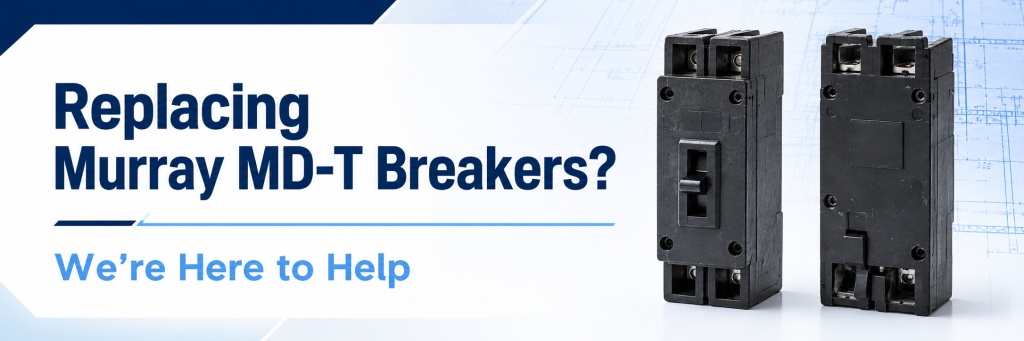
A Murray MD-T is a two-pole, common-trip main breaker used in certain 120/240-volt Murray residential and light-commercial load centers. The family includes applicable 150- and 200-amp models.
What is the difference between Murray MD-T and MD-TR breakers?
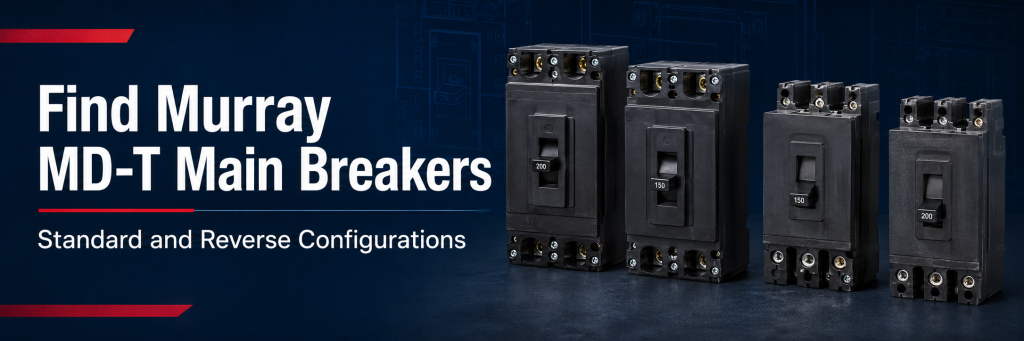
The difference is the physical configuration. MD-T is non-reversible, while MD-TR uses a reverse-oriented arrangement that can change the bus connection, handle direction, terminal positions and required hardware.
What Siemens breaker may replace a Murray MD-T or MD-TR?
Certain Murray load-center labels associate MD-T breakers with Siemens QN breakers and reverse MD-TR breakers with Siemens QNR breakers. The load-center label or Siemens documentation must confirm the specific replacement before installation.
Can I replace a Murray main breaker by matching amperage only?
No. You also need to match voltage, poles, interrupting rating, frame, mounting orientation, terminal positions, conductor range, barriers and retaining hardware.
Does a breaker that fits the bus qualify as an approved replacement?
No. Physical fit doesn’t establish the correct listing, rating or performance. The load-center label and supported manufacturer documentation determine which breaker types are approved.
Why does a Murray main breaker keep tripping?
Repeated tripping can result from an overload, short circuit, loose connection or downstream equipment problem. The cause should be investigated before assuming the breaker is defective.
Can I install a higher-amperage main breaker to stop tripping?
No. The main-breaker rating can’t exceed the rating permitted by the load-center label, bus, service conductors and electrical-system design.
When should the entire Murray load center be replaced?
Load-center replacement may be appropriate when the bus is burned or pitted, corrosion or water damage is extensive, conductors or mounting components are damaged, the label is unreadable, an approved breaker can’t be identified or more capacity is needed.
Murray MD-T and MD-TR Main Breaker Glossary
| Term | Definition |
|---|---|
| Murray MD-T breaker | A non-reversible, two-pole, common-trip main-breaker family used in certain Murray load centers. |
| Murray MD-TR breaker | A reverse-oriented version of the Murray MD-family main breaker designed for load centers requiring that physical configuration. |
| Siemens QN breaker | The Siemens main-breaker family associated with MD-T applications on certain load-center labels. Compatibility must be verified for the specific equipment. |
| Siemens QNR breaker | The reverse-configuration Siemens main-breaker family associated with MD-TR applications on certain load-center labels. Compatibility must be verified. |
| Common trip | A mechanism that opens both poles of a two-pole breaker together when a trip occurs. |
| Load center | An enclosure containing a bus, main or branch circuit breakers, neutral assembly and connections that distribute electrical power. |
| Bus | The conductive assembly inside a load center that supplies power to installed breakers. |
| Interrupting rating | The maximum fault current a breaker can safely interrupt at its specified voltage, commonly expressed in kA. |
| Thermal-magnetic trip | Breaker protection that uses a thermal response for sustained overloads and a magnetic response for high-current short circuits. |
| Catalog number | The complete manufacturer-assigned identifier used to determine a breaker’s family, rating and configuration. |
| Terminal barrier | An insulating component that helps separate and protect breaker terminal connections. |
| Retaining hardware | Manufacturer-specified parts used to secure a breaker in its approved mounting arrangement. |
| Conductor range | The wire sizes and conductor materials permitted for a breaker’s terminals. |