
Replacing Murray MH-T breakers with Siemens QT breakers in load centers.
- Murray MH-T Space-Saving Breakers
- How Murray MH-T Breakers Work
- Murray MH-T Multi-Circuit Breaker Types
- When Murray MH-T Breakers Need Replacement
- Siemens QT Murray MH-T Replacements
- Match Murray MH-T and Siemens QT Catalog Numbers
- Verify Murray Load Center Breaker Compatibility
- Murray Breaker Positions and Circuit Limits
- Match Murray Breaker Poles, Amperage, and Voltage
- Find the Correct Murray MH-T Replacement
- Murray MH-T Breaker FAQ
- Murray MH-T Breaker Glossary
Replacing Murray Breakers?
Get a Breaker QuoteMurray MH-T Space-Saving Breakers
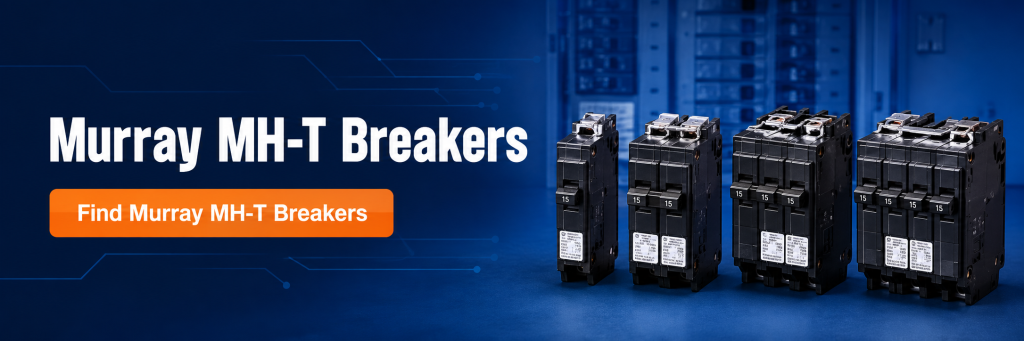
Space-saving Murray MH-T breakers are especially important when an older Murray load center runs out of open areas. Multiple circuits can be placed in smaller load-center locations with MH-T breakers. These breakers can have a tandem, duplex, triplex, or quad setup, depending on the catalog number.
Since Murray breakers are no longer available, the load center overall doesn’t always need to be replaced. When replacing Murray MH-T breakers, Siemens determined that its QT family is the product family to look into. But matching the product families is only the first step. The replacement should be supported by the load-center label, authorized breaker locations, electrical ratings, and circuit configuration.
How Murray MH-T Breakers Work
Plug-in, thermal-magnetic Murray MP-T full-size branch breakers are meant for residential and light-commercial load centers. Circuit density is their main advantage. Compared to traditional full-size breakers, they allow two or more circuits to take up less panel space.
The Siemens Murray-to-Siemens cross-reference guide groups Murray MH-T duplex, triplex, and quadplex breakers with Siemens QT breakers.
Murray MH-T Multi-Circuit Breaker Types
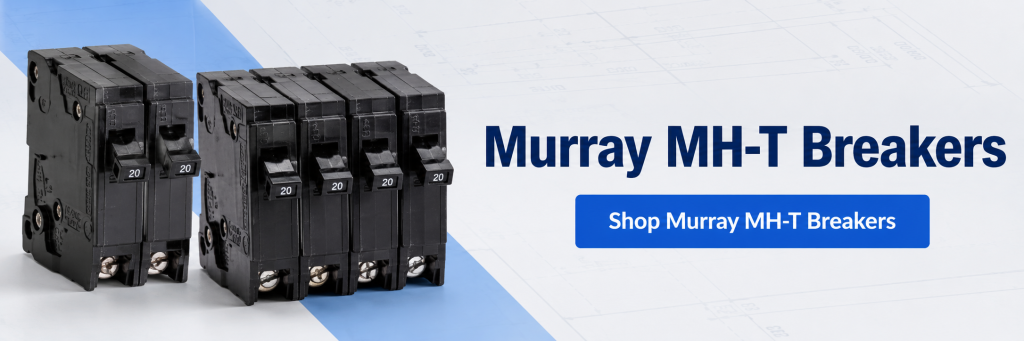
A tandem breaker, also known as a duplex breaker, combines two separate single-pole circuits into a body that is one inch wide. An MP1515 Murray MH-T duplex breaker, for instance, has two 15-amp, 120-volt circuits. One 15-amp circuit and one 20-amp circuit are combined in one area by an MP1520.
A triplex breaker typically takes up two standard spots and combines two single-pole circuits with a two-pole common-trip circuit. Two 20-amp single-pole circuits and a 20-amp two-pole circuit can be produced using a model like the MP22020 Murray MH-T breaker.
When Murray MH-T Breakers Need Replacement
After Siemens’ merger of the Murray product line into matching Siemens families, Murray electrical products were phased out. As a result, finding new Murray-branded replacements is challenging for contractors and property owners.
A breaker probably needs to be replaced if it no longer resets, trips without a clear downstream issue, has damaged terminals, or shows signs of heat. When the needs of a circuit change, a breaker also needs to be replaced. Repeated tripping, however, is a sign of an overload, short circuit, ground fault, broken wire, or malfunctioning linked equipment.
Take a closer look for heat damage, discoloration, arcing, melted insulation, or a damaged bus connection. It’s not safe to replace a damaged bus stab with a new breaker.
Siemens QT Murray MH-T Replacements
The typical Siemens replacement for a Murray MH-T breaker comes from the Siemens QT family. Siemens lists these as space-saving plug-in breakers available in duplex, triplex, and quadplex configurations.
These examples show common Murray catalog numbers related to Siemens QT catalog-number patterns. These are starting points for selection, not permission to install a breaker without checking the load center.
| Murray MH-T breaker | Configuration | Siemens QT breaker to investigate |
|---|---|---|
| MP1515 | Two 15A single-pole circuits | Q1515 |
| MP1520 | One 15A and one 20A single-pole circuit | Q1520 |
| MP2020 | Two 20A single-pole circuits | Q2020 |
| MP21515 | 15A triplex configuration | Q21515CT |
| MP22020 | 20A triplex configuration | Q22020CT |
| MP23030CT2 | Two 30A common-trip circuits | Q23030CT2 |
Compare the complete catalog numbers. Suffixes like CT and CT2 identify an important difference in the breaker’s pole arrangement or trip function.
Match Murray MH-T and Siemens QT Catalog Numbers
A correct Murray MH-T to Siemens QT replacement needs to do more than fit the same opening. Begin by recording the Murray breaker’s complete catalog number exactly as it appears on the label. Photograph the breaker face, side label, handle arrangement, load-center label, and wiring diagram before removing anything.
Then verify:
- Number of poles and protected circuits
- Individual circuit amp ratings
- 120- or 120/240-volt rating
- Common-trip requirements
- Interrupting rating
- Wire size and terminal suitability
- Breaker type permitted by the load-center label
A 15/20-amp duplex can’t automatically replace a 20/20-amp duplex. And a triplex breaker with a common-trip center pair isn’t equivalent to a breaker with several independent single-pole circuits.
Verify Murray Load Center Breaker Compatibility
The reference for breaker compatibility is the label inside the load-center door. Murray meter combinations and some Murray load centers made after January 2002 may use matching Siemens breakers, according to Siemens’ substitute notification. Siemens suggests customers refer to the load center’s wiring schematic for older equipment to determine types of compatible breakers.
This date shouldn’t be the only factor for choosing. Local requirements, breaker locations, labeling, load-center series, and product design are still important. It’s not always a listed or appropriate replacement for a breaker that snaps into the bus.
The Siemens family linked to other Murray applications, including MP-T, AFCI, GFCI, dual-function, and main breakers, are found using the Murray load center breaker replacement guide.
Murray Breaker Positions and Circuit Limits
Tandem or multi-circuit breakers are accepted in specific locations by several load centers. These areas are indicated by a number, shading, or other marking on the wiring schematic. A space-saving breaker installed in an improper location violates the equipment listing and puts an unwanted load on the bus connection.
There’s a maximum circuit count for the load center. Because more tandem breakers can’t physically fit, a panel designated for 20 spaces and 30 circuits cannot be expanded beyond 30 circuits.
Some Murray load-center diagrams also limit the combined rating of MH-T or QT breakers connected to one branch-circuit bus stab. So follow the diagram for the specific load-center catalog number instead of relying on a general compatibility chart.
Match Murray Breaker Poles, Amperage, and Voltage
Each circuit must keep the correct overcurrent protection. Breaker amperage is selected according to conductor size, load characteristics, equipment requirements, and applicable electrical codes. It shouldn’t be increased just because a circuit trips frequently.
Voltage and pole configuration matter. A 120-volt branch circuit generally uses a single-pole breaker. A 240-volt load normally requires a two-pole common-trip breaker connected across both legs of the system. Handle ties and common-trip mechanisms aren’t interchangeable concepts, so the replacement must provide the required function.
Interrupting rating needs to equal or exceed the available fault current at the load center. Many MH-T and QT residential breakers have a 10 kA rating, but you should verify the actual breaker and equipment requirements and not assume that rating applies universally.
Find the Correct Murray MH-T Replacement
Start your search with the complete Murray catalog number and the load-center catalog number. The Murray circuit breaker catalog can identify the original breaker’s configuration and ratings. Compare those details with the corresponding Siemens QT product.
If an approved Siemens replacement isn’t available or the load-center label doesn’t establish compatibility, source the correct original Murray breaker. The condition of the bus, enclosure, neutral assembly, conductors, and existing breakers should be considered. Extensive damage or multiple obsolete components make load-center replacement more practical than another individual breaker repair.
Because load centers contain hazardous energized parts even when the main breaker is switched off, identification and installation should be handled by a qualified electrician. The correct Murray tandem breaker replacement must match the circuit and be specifically allowed for the load center, not just fit into the available space.
Murray MH-T Breaker FAQ
Murray MH-T Breaker Glossary
| Term | Definition |
|---|---|
| Murray MH-T breaker | A discontinued family of space-saving, plug-in circuit breakers designed for compatible Murray residential and light-commercial load centers. |
| Siemens QT breaker | The Siemens space-saving breaker family identified as the replacement family to investigate for many Murray MH-T applications. Compatibility must still be verified using the load-center label. |
| Tandem breaker | A breaker containing two independent single-pole circuits in a body that occupies one standard breaker space. |
| Duplex breaker | Another name commonly used for a tandem breaker with two independent single-pole circuits. |
| Triplex breaker | A space-saving breaker that typically combines two single-pole circuits with one two-pole common-trip circuit. |
| Quad breaker | A breaker that provides four poles or circuit positions within the space normally occupied by two full-size breakers. |
| Common trip | A mechanism that causes all connected poles of a multi-pole breaker to open together when one pole trips. |
| Load center | An electrical enclosure containing the bus, circuit breakers, neutral assembly, and connections that distribute power to branch circuits. |
| Bus stab | The part of the load-center bus onto which a plug-in circuit breaker connects. |
| Catalog number | The complete manufacturer-assigned number used to identify a breaker’s amperage, pole arrangement, trip configuration, and other characteristics. |
| Interrupting rating | The maximum fault current a breaker can safely interrupt at its specified voltage, commonly expressed in thousands of amps or kA. |
| Circuit count | The maximum number of branch circuits a load center is designed and listed to support. |
| Approved breaker position | A load-center location specifically identified by the manufacturer as suitable for a tandem or other space-saving breaker. |
| Thermal-magnetic protection | Breaker protection that uses a thermal response for overloads and a magnetic response for short circuits. |