
Siemens QDF dual-function breakers combine AFCI, GFCI, overload and short-circuit protection. Compare Q115DF, Q120DF and related models, ratings and neutral configurations.
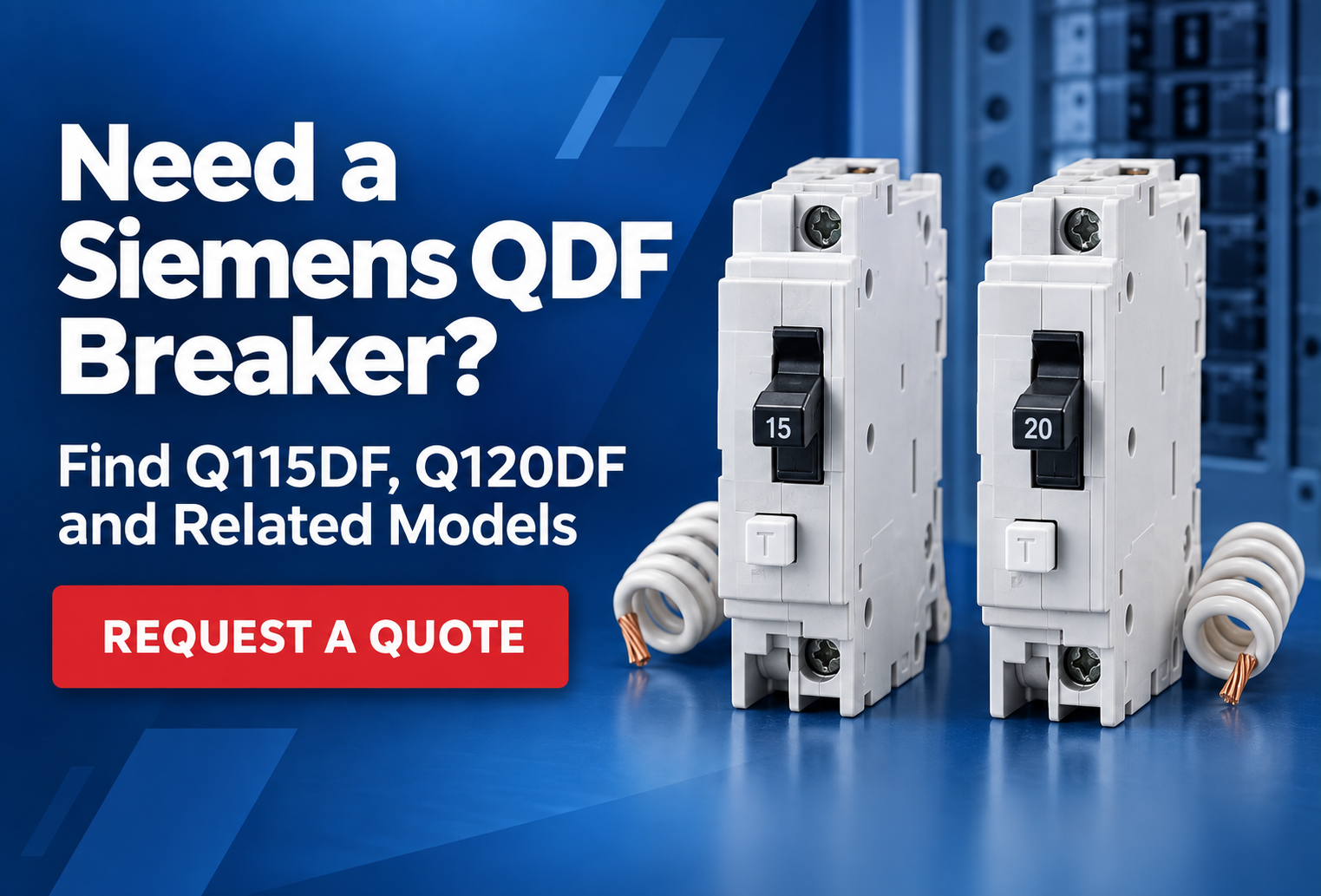
Need a Siemens QDF Breaker?
Get a Breaker QuoteSiemens QDF Breakers
QDF Dual Protection
AFCI and GFCI
QDF and QFGA2
QDF Ratings
Siemens QDF Breaker Ratings and Catalog Numbers
The following table shows the principal plug-in QDF catalog-number patterns.
| Siemens catalog number | Siemens type | Poles | Amperage | Voltage | Interrupting rating | Neutral arrangement |
|---|---|---|---|---|---|---|
| Q115DF | QFGA2 | 1 | 15A | 120V | 10 kA | Pigtail |
| Q120DF | QFGA2 | 1 | 20A | 120V | 10 kA | Pigtail |
| Q115DFH | QFGAH2 | 1 | 15A | 120V | 22 kA | Pigtail |
| Q120DFH | QFGAH2 | 1 | 20A | 120V | 22 kA | Pigtail |
| Q115DFHH | HQFGA2 | 1 | 15A | 120V | 65 kA | Pigtail |
| Q120DFHH | HQFGA2 | 1 | 20A | 120V | 65 kA | Pigtail |
| Q115DFN | QFGA2N | 1 | 15A | 120V | 10 kA | Plug-on neutral |
| Q120DFN | QFGA2N | 1 | 20A | 120V | 10 kA | Plug-on neutral |
Use this table for identification. Confirm the complete catalog number and load-center compatibility before ordering or installation.
Q115DF vs. Q120DF
Neutral Connections
Load-Center Compatibility
Replace a QDF Breaker
Select a Replacement
Find QDF Breakers
QDF Breaker Summary
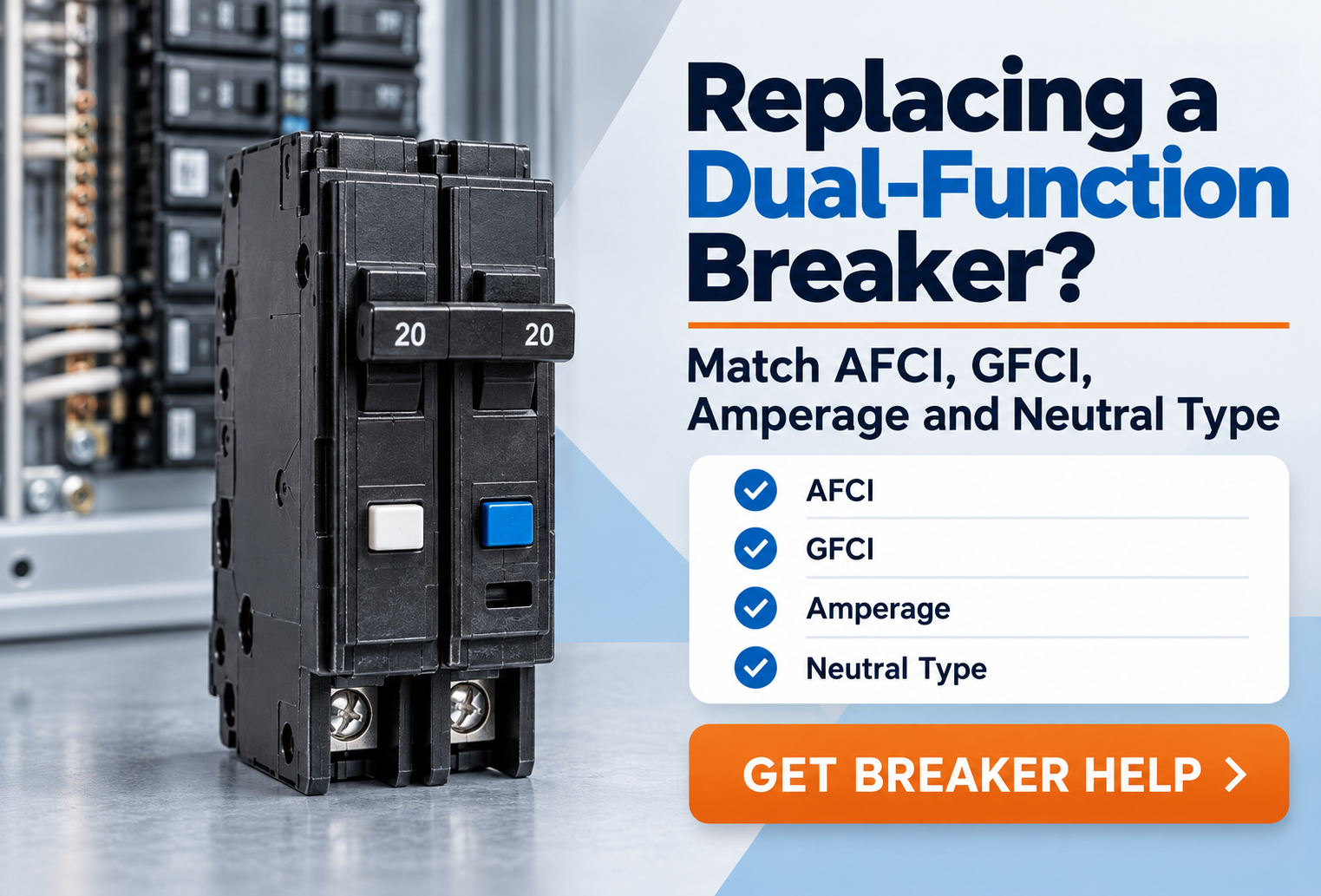
Siemens QDF Breaker FAQ
What is a Siemens QDF dual-function breaker?+
A Siemens QDF breaker combines thermal-magnetic overcurrent protection, combination-type AFCI protection and Class A GFCI protection in one branch-circuit breaker. Common QDF models are one-pole, 120-volt breakers rated 15 or 20 amps.
What does QDF mean on a Siemens breaker?+
QDF appears in Siemens catalog numbers for dual-function AFCI/GFCI breakers, including Q115DF and Q120DF. The complete catalog number also communicates amperage and may include suffixes identifying the interrupting rating or neutral configuration.
Is Siemens QDF the same as Type QFGA2?+
They are related designations. QDF is used in catalog numbers, while QFGA2 is Siemens’ type designation for standard 10 kA plug-in dual-function breakers. QFGAH2 and HQFGA2 identify higher interrupting-rating versions, and QFGA2N identifies plug-on-neutral models.
What is the difference between Q115DF and Q120DF?+
The Q115DF is a 15-amp breaker, while the Q120DF is a 20-amp breaker. Both are normally one-pole, 120-volt, 10 kA dual-function models. You can’t substitute the 20-amp model for the 15-amp model unless the entire branch circuit is designed and approved for 20 amps.
Can Q115DFN replace Q115DF?+
Not automatically. Q115DFN is a plug-on-neutral breaker, while Q115DF uses a neutral pigtail. The plug-on-neutral model requires a compatible load center designed and labeled for that breaker type. Confirm the panel label, neutral arrangement and Siemens documentation before substituting either version.
Can a standard Siemens QP breaker replace a QDF breaker?+
A standard QP breaker shouldn’t replace a QDF breaker when the circuit requires AFCI and GFCI protection. Although both breaker families may provide overload and short-circuit protection, a standard QP model doesn’t provide the combined protective functions of a QDF breaker.
Why does a Siemens QDF breaker keep tripping?+
Repeated tripping can indicate an overload, short circuit, ground fault, hazardous arcing condition, incorrect neutral wiring, shared or crossed neutral, damaged cord or faulty connected equipment. Troubleshoot the circuit before assuming the breaker has failed.
Siemens QDF Breaker Glossary
| Term | Definition |
|---|---|
| AFCI | Arc-fault circuit interrupter. A protective device that monitors a circuit for characteristics associated with hazardous electrical arcing. |
| Class A GFCI | Ground-fault protection intended for personnel. Siemens identifies 5 mA Class A GFCI protection for the QDF family. |
| Combination-type AFCI | An AFCI designed to respond to qualifying series and parallel arcing conditions within its listed operating parameters. |
| Dual-function breaker | A circuit breaker that combines AFCI and Class A GFCI protection with overload and short-circuit protection. |
| GFCI | Ground-fault circuit interrupter. A device that responds when current imbalance indicates leakage from the intended circuit path. |
| Interrupting rating | The maximum prospective fault current a breaker is designed to interrupt safely at its specified voltage, commonly stated in kA. |
| Neutral pigtail | A factory-connected neutral conductor extending from the breaker for connection to the load center’s neutral bar. |
| Plug-on neutral | A breaker connection that attaches directly to an approved neutral rail instead of using a separate neutral pigtail. |
| QDF | The designation used within Siemens dual-function breaker catalog numbers such as Q115DF and Q120DF. |
| QFGA2 | The Siemens type designation associated with standard 10 kA plug-in QDF dual-function breakers. |
| Thermal-magnetic trip | A trip system using a thermal response for sustained overloads and a magnetic response for high-current short circuits. |