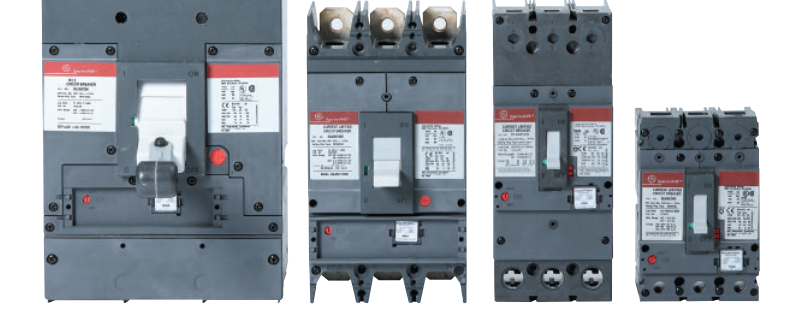
Spectra RMS circuit breaker has electronic trip protection that holds up in today’s demanding electrical environments.
Low Voltage Breakers with Trip Protection, RMS Sensing
If you operate in an industrial or commercial building, you have probably seen an ABB Spectra RMS circuit breaker in the field. These breakers, originally developed by GE and now part of ABB’s low-voltage portfolio, built their name by providing superior electronic trip prevention, real RMS sensing.
They existed long before the term “smart breakers” became an industry buzzword.
ABB is changing its product roadmap to newer platforms like ABB Tmax XT,
Spectra RMS electronic trip circuit breakers are extremely useful, particularly for maintaining, repairing, or replacing existing power systems
An Spectra RMS circuit breaker is a molded case circuit breaker (MCCB) that includes a digital electronic trip unit instead of typical thermal-magnetic elements.
That electronic trip unit measures current with real RMS sensing, providing good protection when loads are affected by harmonics, VFDs, UPS systems, or nonlinear equipment.
You Get:
– More predictable tripping – Better coordination – Less nuisance downtime
These breakers were designed for real-world industrial conditions — not just lab-perfect sine waves.
Why Electronic Trip Molded Case Circuit Breakers Still Matter
If you’ve ever had a breaker trip for “no obvious reason,” you appreciate an electronic trip molded case circuit breaker.
Unlike mechanical trip mechanisms, electronic trip units let you adjust protective settings without replacing the entire breaker.
This design laid groundwork for modern breaker platforms — including today’s ABB Tmax XT lineup.
Spectra RMS electronic trip breakers give you:
– Adjustable long-time, short-time, and instantaneous protection – Rating plugs instead of fixed amp limits – Consistent performance across a wide load range
RMS Sensing Circuit Breakers for Modern Electrical Loads
Power systems today are tougher on protection devices. Variable frequency drives, LED lighting, switch-mode power supplies, and data center loads all have waveform distortion.
That’s where RMS sensing circuit breakers stand out.
Spectra RMS breakers use true RMS digital sensing, which means the breaker responds to the actual heating effect of current — not just peak values. This means:
– Accurate overload protection – Fewer false trips – Better protection for motors, transformers, and feeders
Industrial Electronic Trip Breakers Installed Base
One reason industrial electronic trip breakers like Spectra RMS are requested in so many existing installations. You’ll find them in:
– Manufacturing plants – Data centers – Hospitals and healthcare facilities – Water and wastewater infrastructure – OEM equipment and packaged systems
When a breaker fails in these environments, replacing it with a different platform isn’t always practical.
Many times, using a like-for-like Spectra RMS replacement avoids panel modifications, downtime, and expensive re-certification.
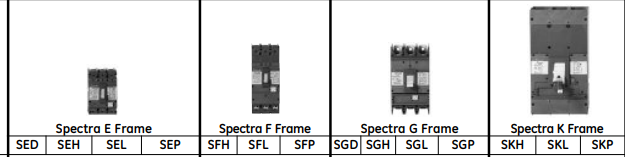
ABB / GE Spectra RMS Circuit Breaker Models (Selection Reference)
Large-frame Spectra RMS breaker suited for main distribution and switchboard applications with adjustable trip protection.
Visit relectric.com to review products shown in the above table.
ABB Molded Case Breaker Applications and Accessories
Another reason Spectra RMS breakers have a large user base is their modular accessory design.
ABB (and previously GE) engineered these breakers so accessories could be shared across frames, making inventory and installation easier.
Common ABB molded case circuit breaker applications include:
– Shunt trips for emergency shutdown – Undervoltage releases for power-loss protection – Auxiliary switches for status indication – Alarm contacts for remote monitoring
ABB’s Transition to Tmax XT — What It Means for You
Remember, ABB is phasing out Spectra RMS breakers in favor of the Tmax XT platform for new production. But that doesn’t make Spectra RMS obsolete. Tmax XT adds:
• Enhanced digital communication • Advanced power monitoring • Compact, next-generation designs
If you’re working in an existing installation, Spectra RMS breakers remain a practical, reliable solution. In many cases, replacing a legacy breaker with a newer platform needs:
• New mounting hardware • Panel or switchgear modifications • Coordination studies • Costly downtime
Choosing the Right ABB Spectra RMS Circuit Breaker
When chossing a Spectra RMS breaker, you’re usually matching frame size, amp rating, voltage class, and interrupting capacity to an existing system. The table below gives a quick, high-level reference you can use when evaluating options.
Frame Type
Typical Amp Range
Voltage Class
Interrupting Capacity (Typical)
Common Applications
SE150
15–150 A
Up to 600 Vac
Up to 100 kA @ 480 Vac
Branch circuits, small feeders
SF250
150–250 A
Up to 600 Vac
Up to 100 kA @ 480 Vac
Distribution panels, MCCs
SG600
300–600 A
Up to 600 Vac
Up to 100 kA @ 480 Vac
Large feeders, motor protection
SK1200
800–1200 A
Up to 600 Vac
Up to 100 kA @ 480 Vac
Main distribution, switchboards
Note: Actual ratings depend on configuration, trip unit, and installation conditions.
Why Contractors Still Trust ABB Spectra RMS Breakers
While ABB moves forward with newer platforms, ABB Spectra RMS electronic trip circuit breakers still earn trust because they have what matters most in the field:
Predictable protection
Proven durability
Flexible adjustment
Compatibility with existing systems
If your job is to keep power flowing — not reinventing the distribution system — Spectra RMS breakers are a smart, practical choice.