Mini Circuit Breaker Quick-Start Guide

Mini Circuit Breakers protect panels and circuits while allowing fast, modular, space-saving maintenance.

Need Miniature Breakers?

Get Mini Breaker Quote
Introduction

What’s an Industrial Miniature Circuit Breaker (MCB)?

This is a practical Mini Circuit Breaker Quick-Start tour of an industrial miniature circuit breaker (MCB). After reading, you’ll understand UL 489 vs UL 1077, how MCB trip curves B, C, D affect unwanted trips, and walk through a mini miniature circuit breaker selection guide—then we’ll go over installation tips, system coordination basics, and common pitfalls.

Industrial miniature circuit breakers (MCBs) protect control panels and branch circuits on tight DIN-rail spaces. You get fast trip response, modular accessories, and clean panel layouts. Also, there’s predictable protection and easy maintenance without the bulk of larger molded-case breakers. For specific models, see Eaton Miniature Circuit Breakers and Supplementary Protectors.

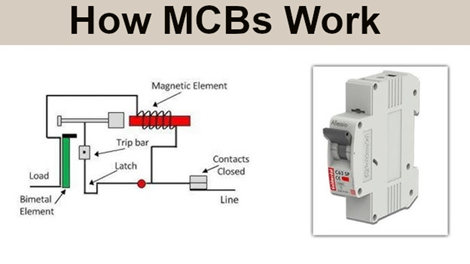
Mini breaker diagram
Mini breaker diagram showing electrical contacts that open and close to interrupt current during faults (Courtesty WikiMedia).
UL 489 vs UL 1077

Miniature Breaker Code Compliance and SCCR Safety

Knowing industry standards for mini circuit breakers, whether they’re new, used, or refurbished breakers, keeps you compliant and out of trouble. UL 489 devices handle branch-circuit protection; UL 1077 devices are supplementary protectors for downstream (equipment-fed and controlled after the breaker) gear. During the Mini Circuit Breaker Quick-Start, you’ll need to match the miniature breaker to the service duty, short-circuit rating, and labeling requirements in your breaker panel.

Pass inspections the first time. Using a UL 489 breaker where branch-circuit protection is required satisfies inspectors and avoids rework.

Protect yourself from liability. The right listing in the right place means your panel meets code and manufacturer instructions — good for warranty and insurance claims.

Fewer nuisance trips, less downtime. Proper curve/duty selection trips when it should (faults) and stays on when it should (motor inrush), keeping lines running.

Accurate Short-Circuit (SCCR) labeling. Correct upstream component ratings give a safer panel SCCR, so you can avoid faulty currents.

MCB Trip Curves

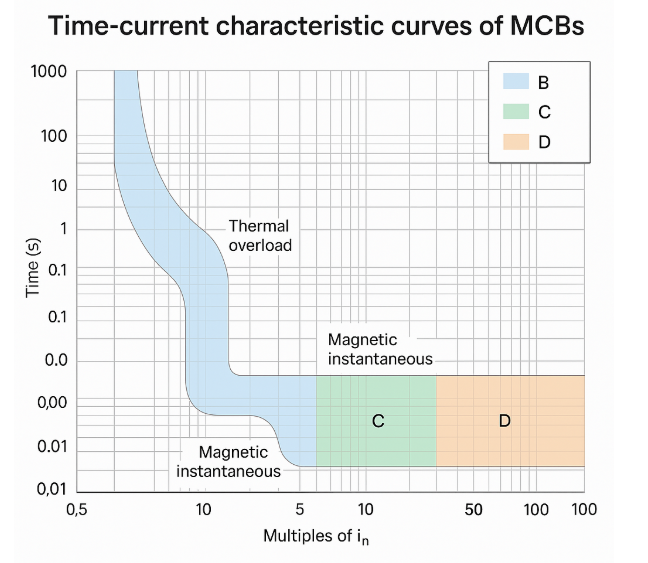
How They Trip: MCB Trip Curve Values

Tripping attributes of miniature circuit breakers specify how much overcurrent it takes for the breaker to trip. The MCB trip curves B C D define how quickly your breaker trips under fault. B is sensitive for resistive loads, C for mixed and motor loads, D for high inrush.

Pick the curve that fits the startup current, coordination, and trip tolerance.

Image: Electrical Marketing
Fast Panel Mounting

Mounting a DIN Rail Miniature Circuit Breaker

mini circuit breakers

A DIN rail miniature circuit breaker drops into modular panels quickly. You’ll snap it on, include accessories, and keep wiring neat. Pay attention to ventilation, pole count, and busbar compatibility so your panel stays cool, organized, and straightforward to service later.

Example: Eaton FAZ miniature circuit breaker
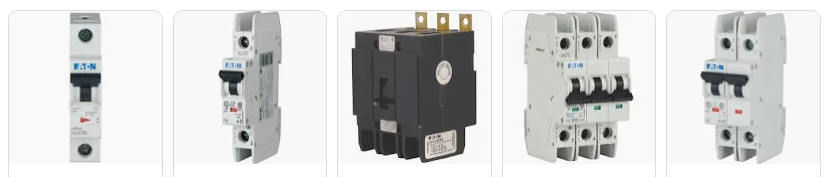
The Eaton FAZ miniature circuit breaker family covers B/C/D curves, multiple poles, and accessories like shunt trips and auxiliaries. You get global part availability, clear markings, and strong short-circuit ratings—ideal for standardized builds across OEM machines and retrofit control panels.

Part Number Description
FAZ-B1/1-NA MCB, B curve, 1 A, 1-pole, up to 277 VAC (UL 489), DIN-rail
FAZ-B6/1-NA MCB, B curve, 6 A, 1-pole, up to 277 VAC (UL 489), DIN-rail
FAZ-B10/1-NA MCB, B curve, 10 A, 1-pole, up to 277 VAC (UL 489), DIN-rail
FAZ-B20/1-NA MCB, B curve, 20 A, 1-pole, up to 277 VAC (UL 489), DIN-rail
FAZ-B32/1-NA MCB, B curve, 32 A, 1-pole, up to 277 VAC (UL 489), DIN-rail
FAZ-C6/1-NA MCB, C curve, 6 A, 1-pole, up to 277 VAC (UL 489), DIN-rail
FAZ-C10/1-NA MCB, C curve, 10 A, 1-pole, up to 277 VAC (UL 489), DIN-rail
FAZ-C16/1-NA MCB, C curve, 16 A, 1-pole, up to 277 VAC (UL 489), DIN-rail
FAZ-C20/2-NA MCB, C curve, 20 A, 2-pole, up to 480Y/277 VAC (UL 489), DIN-rail
FAZ-C32/3-NA MCB, C curve, 32 A, 3-pole, up to 480Y/277 VAC (UL 489), DIN-rail
FAZ-D6/1-NA MCB, D curve, 6 A, 1-pole, up to 277 VAC (UL 489), DIN-rail
FAZ-D10/1-NA MCB, D curve, 10 A, 1-pole, up to 277 VAC (UL 489), DIN-rail
FAZ-D16/3-NA MCB, D curve, 16 A, 3-pole, up to 480Y/277 VAC (UL 489), DIN-rail

Visit Relectric Eaton FAZ Mini Breaker Product Page
Load Current and Voltage

Sizing Industrial Miniature Circuit Breakers

When you size an industrial miniature circuit breaker (MCB) during the Mini Circuit Breaker Quick-Start, begin with load current and voltage, then confirm interrupting capacity at your available fault current. Check ambient temperature, conductor size, and derating. Document the chosen curve and accessories for future reference.

Compliance Choices: UL 489 vs UL 1077
Still unsure whether to follow UL 489 or UL 1077? If the breaker protects branch-circuit conductors, choose UL 489. If it’s just protecting a device inside a larger protected circuit, UL 1077 is ok. Verify the upstream OCPD (Overcurrent Protective Device), SCCR (Short-Circuit Current Rating), and labeling before finalizing.

Standardize for Faster Assembly

Panel Efficiency with a DIN Rail Breaker

Standardize on a DIN rail miniature circuit breaker to assemble panels faster with fewer headaches. Use comb busbars (simplifies wiring by providing multiple connection points in a single strip) for neat line feeds, torque terminals correctly, and route control wiring cleanly. Quick accessory changes keep downtime low and simplify field modifications or expansions.

Upgrades & Retrofits with an industrial miniature circuit breaker (MCB)
Upgrading to an industrial miniature circuit breaker (MCB) in older panels? Confirm short-circuit ratings, conductor insulation class, and enclosure heat rise. Map existing loads to new curves, then label clearly. You’ll improve safety, serviceability, and compliance without re-engineering everything.

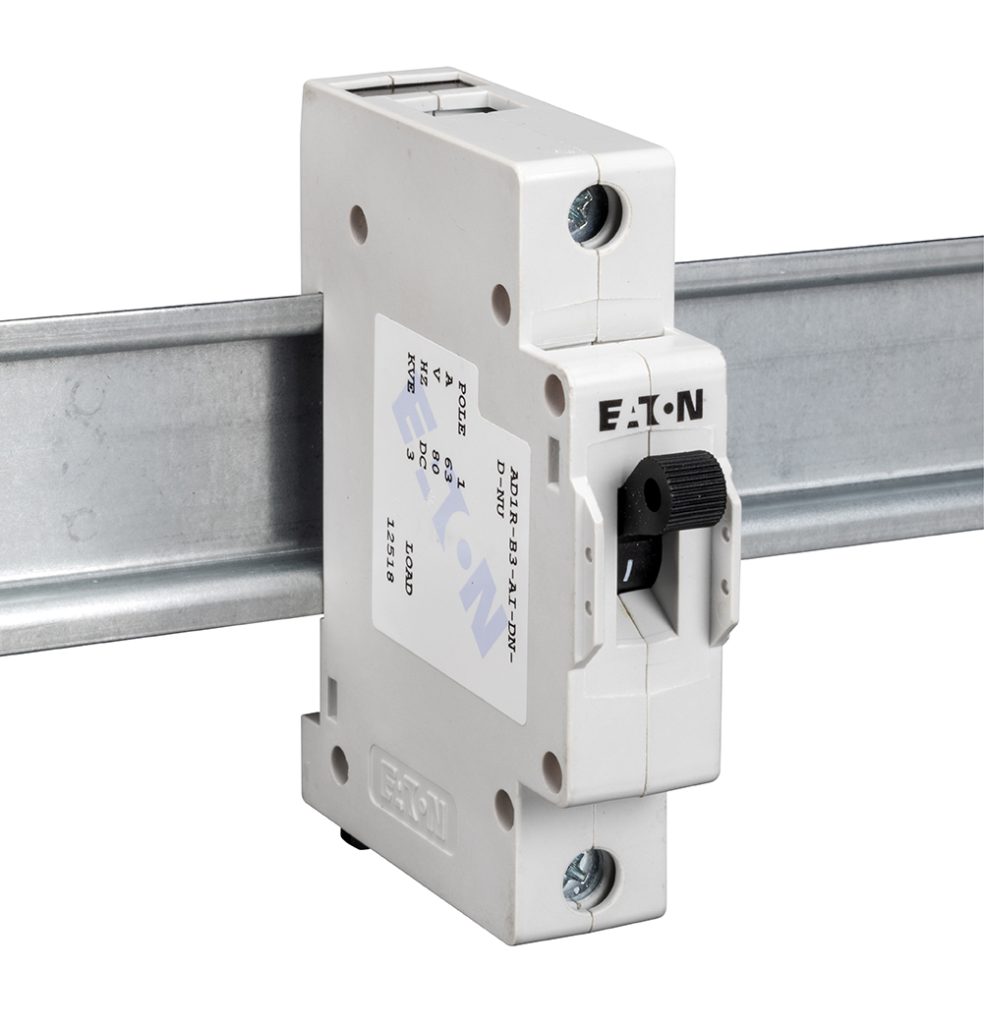
DIN rail mounting: Precise, stable and reliable protection against overload or short-circuits. (Courtesy: Eaton)
Points to Remember

MCB Essentials: Trip Curves, DIN-Rail Standardization

Key Takeaways:
Mini Circuit Breaker Quick-Start Points to Remember: match UL 489 vs UL 1077 to duty, use MCB trip curves B C D for load behavior, and standardize on DIN rail miniature circuit breaker families (e.g., Eaton FAZ miniature circuit breaker) to streamline builds, documentation, and maintenance.

You can size for load and interrupting capacity, confirm available fault current, label a SCCR (Short-Circuit Current Rating), and pick the right accessories. In short: choose the correct listing, apply the right curve, and document clearly for safe, compliant panels.

You should now know the difference between UL 489 branch-circuit breakers and UL 1077 supplementary protectors, how MCB trip curves B, C, and D affect nuisance trips and coordination, and why standardizing on DIN-rail MCBs streamlines your job.

Glossary Terms to Know

  • Branch Circuit — The wiring and devices downstream of the final overcurrent protective device feeding loads.
  • Interrupting Capacity (SCCR) — The maximum fault current a device can safely interrupt.
  • Inrush Current — A short surge of current when equipment starts, often driving curve selection.
  • Selectivity (Coordination) — So that only the nearest protective device trips for a fault.
  • Derating — Reducing a device’s nominal rating to account for temperature, grouping, or altitude.
  • Auxiliary Contact — Low-level signaling contact indicating breaker status.
  • Shunt Trip — Coil that opens the breaker remotely for safety interlocks or emergency stops.

Mini Circuit Breaker FAQ

When should I choose UL 489 over UL 1077?

Pick UL 489 for branch-circuit protection of conductors; UL 1077 is only for supplementary equipment protection downstream of a compliant OCPD.

Which curve—B, C, or D—do I use for motors?

Start with C for typical motors; use D when you expect high inrush or hard starts. Validate with motor data.

Can I mix brands on a DIN rail?

Physically, yes, but terminal geometry, accessories, and ratings differ. Keep families consistent for documentation and service.

How do I size the short-circuit rating?

Obtain available fault current at the panel, then select an MCB with equal or higher interrupting capacity, considering upstream protection.

Do I need accessories?

Aux contacts help with status indication; shunt trips integrate with safety circuits. Add only what your control logic requires.

What causes nuisance tripping?

Misapplied curves, undersized conductors, loose terminations, or unexpected inrush. Measure inrush and retorque connections.

Are mini breakers a replacement for MCCBs?

Not generally. Minis excel in control panels and lighter branch loads. Use MCCBs where higher currents or advanced protection functions are required.

Looking for Circuit Breaker Troubleshooting Tips and Advice?
Common Circuit Breaker Problems
How to Replace a Circuit Breaker
How to Test a Circuit Breaker
Installing Circuit Breakers
Types of Circuit Breakers