
Siemens Electronic Trip vs Thermal Magnetic Breakers

Need Siemens Breakers?

Get Breaker Quote

Siemens Electronic Trip and Thermal Magnetic Breaker

… know the differences to improve system reliability, safety, and future expansion.
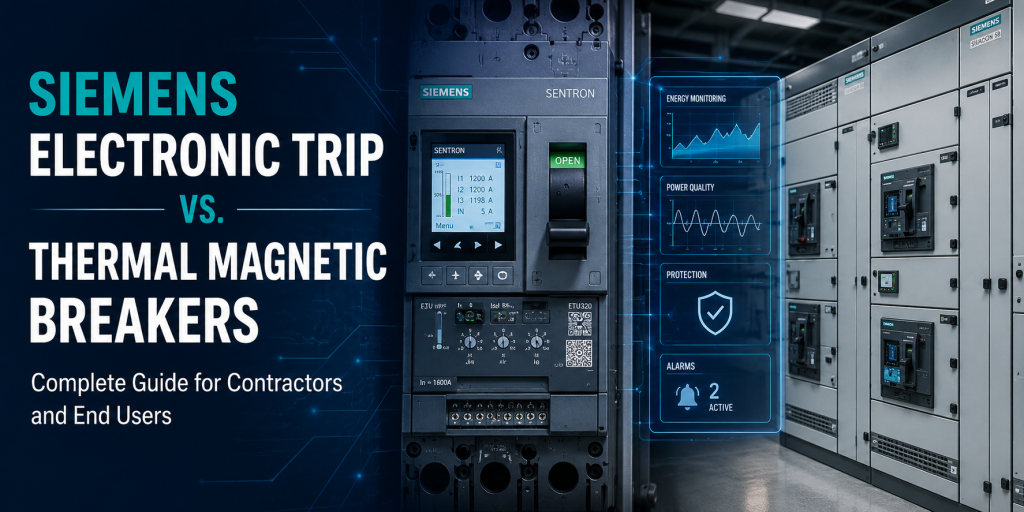
Designing, , maintaining, or updating power equipment?

You’ll have to decide between a Siemens Electronic Trip Breaker and a Siemens Thermal Magnetic Breaker. Both systems provide overcurrent protection, but they work differently depending on the application.

Contractors working on a commercial project and facility managers need to know these differences to improve system reliability, enhance safety, and support future expansion.

Learn more about electronic trip units and thermal magnetic breakers.

Siemens Electronic Trip vs Thermal Magnetic Breakers

Detect and respond to electrical faults.

Both systems provide overcurrent protection, but they work differently

Difference Between Electronic Trip and Thermal Magnetic

The main difference between these breaker technologies is how they detect and respond to electrical faults.

A thermal magnetic breaker uses mechanical components. The thermal portion responds to overload conditions by sensing heat generated from excessive current flow. The magnetic portion reacts almost instantly to high fault currents using an electromagnetic coil to trip the breaker.

An electronic trip breaker uses current sensors and a microprocessor-based trip unit. Instead of relying on heat buildup, the breaker continuously monitors current electronically and compares it to programmed protection settings. When a setting is exceeded, the breaker trips according to protection parameters.

Electronic trip units use programmable logic for significantly greater flexibility than thermal magnetic designs.

Advanced protection and more control

… electronic trip units let you adjust multiple protection functions.

Electronic Trip Breakers Explained

A Siemens Electronic Trip Breaker is designed to provide advanced protection and more control over your electrical distribution system. Unlike traditional thermal magnetic breakers, electronic trip units let you adjust multiple protection functions.
This means you can customize breaker performance based on your facility’s operating requirements instead of relying solely on factory-set trip characteristics.

Electronic trip breakers are commonly used in:
Data centers
Manufacturing facilities
Hospitals
Utility systems
Water treatment plants
Large commercial buildings

These applications often require precise coordination and advanced protection capabilities that thermal magnetic breakers cannot easily provide.

Advantages of a Siemens Electronic Trip Unit

Long-Time Protection protects conductors and equipment from sustained overload conditions

LSIG Protection in Siemens Circuit Breakers

One of the biggest advantages of a Siemens Electronic Trip Unit is availability of LSIG Protection. LSIG stands for:

Long-Time Protection
Short-Time Protection
Instantaneous Protection
Ground Fault Protection

Each function protects your electrical system from different fault conditions.
Long-Time Protection protects conductors and equipment from sustained overload conditions. Short-Time Protection maintains coordination between upstream and downstream breakers. Instantaneous Protection provides immediate response to severe short-circuit events.

Ground Fault Protection detects unwanted current flow to ground avoiding equipment damage.

These functions create more sophisticated protection strategy than standard thermal magnetic protection.

Electronic trip technology advantages

… adjust protection settings for new loads, generators, transformers, or distribution equipment.
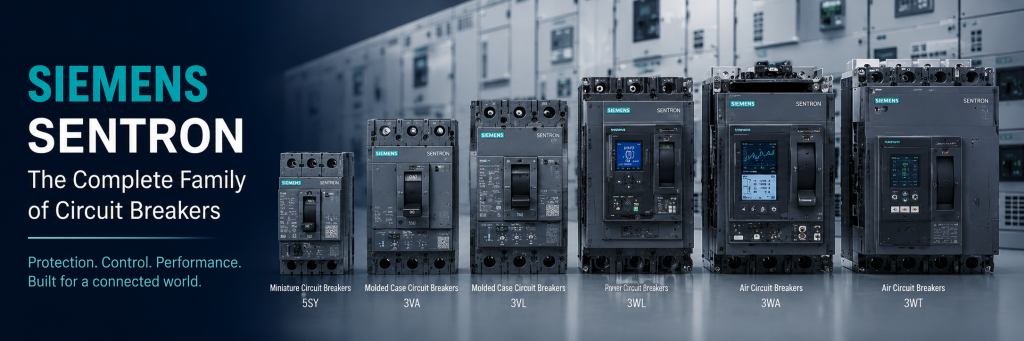
Siemens Electronic Trip Unit Applications

Complex industrial facilities need adjustable protection. Electronic trip technology gives important advantages improving system performance.
Instead of replacing breakers when operating conditions change, you can adjust protection settings for new loads, generators, transformers, or distribution equipment.

Important benefits include:
Adjustable protection settings and Improved system coordination
Reduced nuisance tripping and Ground fault protection capabilities
Arc flash mitigation support, Enhanced equipment protection

siemens sentron catalog

Answer depends on application, budget and operations

Both serve important purposes in modern power distribution systems.

Electronic Trip vs Thermal Magnetic: Which Should You Choose?

The answer depends on your application, budget and operations. For standard commercial applications, a Siemens Thermal Magnetic Breaker is a good solution. These breakers are cost-effective, simple to install, and are reliable.

They are used for:
Branch circuits
Small commercial facilities
Basic feeder protection
General-purpose power distribution

If your project needs advanced protection functions, selective coordination, ground fault protection, or future flexibility, a Siemens Electronic Trip Breaker provides long-term value. The initial cost may be higher, but the additional protection capabilities can reduce downtime, improve safety, and simplify future system modifications.

Part Number Description Breaker Type
ED63B100 Siemens / ITE ED frame molded case circuit breaker, 3-pole, 100 amp, commonly used for feeder and branch circuit protection. Thermal Magnetic
HED43B100 Siemens HED frame molded case circuit breaker, 3-pole, 100 amp, high-interrupting style for commercial power distribution. Thermal Magnetic
JD63B250 Siemens Sentron JD frame molded case circuit breaker, 3-pole, 250 amp, used in panelboards, switchboards, and industrial equipment. Thermal Magnetic
HJD63B400 Siemens Sentron HJD frame molded case circuit breaker, 3-pole, 400 amp, commonly selected for higher interrupting capacity applications. Thermal Magnetic
LD63B600 Siemens Sentron LD frame molded case circuit breaker, 3-pole, 600 amp, used for larger feeder and equipment protection. Thermal Magnetic
ND63B800 Siemens Sentron ND frame molded case circuit breaker, 3-pole, 800 amp, often used in switchboards and large distribution systems. Thermal Magnetic
SJD69300 Siemens Sentron JD frame electronic trip breaker, 3-pole, 300 amp, used where adjustable trip protection is needed. Electronic Trip
SJD69400 Siemens Sentron JD frame electronic trip breaker, 3-pole, 400 amp, commonly used for adjustable feeder protection. Electronic Trip
SLD69600 Siemens Sentron LD frame electronic trip breaker, 3-pole, 600 amp, used in commercial and industrial distribution systems. Electronic Trip
SND69800 Siemens Sentron ND frame electronic trip breaker, 3-pole, 800 amp, used for larger loads requiring adjustable electronic protection. Electronic Trip
What is the difference between electronic trip and thermal magnetic breakers?
Electronic trip breakers use sensors and trip units to monitor current and provide adjustable protection. Thermal magnetic breakers use heat and magnetic force to trip during overloads and short circuits.
Are Siemens electronic trip breakers better than thermal magnetic breakers?
They are better for applications that need adjustable settings, LSIG protection, selective coordination, or detailed system protection. Thermal magnetic breakers are often better for simpler, lower-cost applications.
What does LSIG mean on a Siemens breaker?
LSIG stands for long-time, short-time, instantaneous, and ground-fault protection. These functions help coordinate breaker operation and improve protection in commercial and industrial power systems.
When should you choose a thermal magnetic breaker?
Choose a thermal magnetic breaker when the application is straightforward, cost-sensitive, and does not require adjustable trip settings or advanced coordination.
When should you choose a Siemens electronic trip breaker?
Choose a Siemens electronic trip breaker when you need adjustable protection, improved selective coordination, ground-fault protection, or better control over how the breaker responds to faults.
Do electronic trip breakers help with selective coordination?
Yes. Electronic trip breakers can be adjusted so that the breaker closest to the fault trips first, helping reduce unnecessary outages upstream.
Are Siemens electronic trip breakers used in switchboards?
Yes. Siemens electronic trip breakers are commonly used in switchboards, panelboards, motor control centers, and other commercial or industrial power distribution systems.
Glossary Term Definition
Electronic Trip Breaker A circuit breaker that uses electronic sensing and a trip unit to monitor current and control breaker response.
Thermal Magnetic Breaker A breaker that trips using heat for overloads and magnetic force for short circuits.
LSIG Long-time, short-time, instantaneous, and ground-fault protection functions used for adjustable circuit protection.
Long-Time Protection A trip function that protects against sustained overload conditions.
Short-Time Protection A delay-based trip function that allows downstream breakers time to clear faults first.
Instantaneous Protection A trip function that opens the breaker immediately during high-level short-circuit conditions.
Ground-Fault Protection Protection that detects current leakage to ground and trips the breaker when needed.
Selective Coordination A design approach where the breaker closest to the fault trips first to reduce unnecessary outages.
Trip Unit The part of an electronic breaker that measures current and controls when the breaker trips.