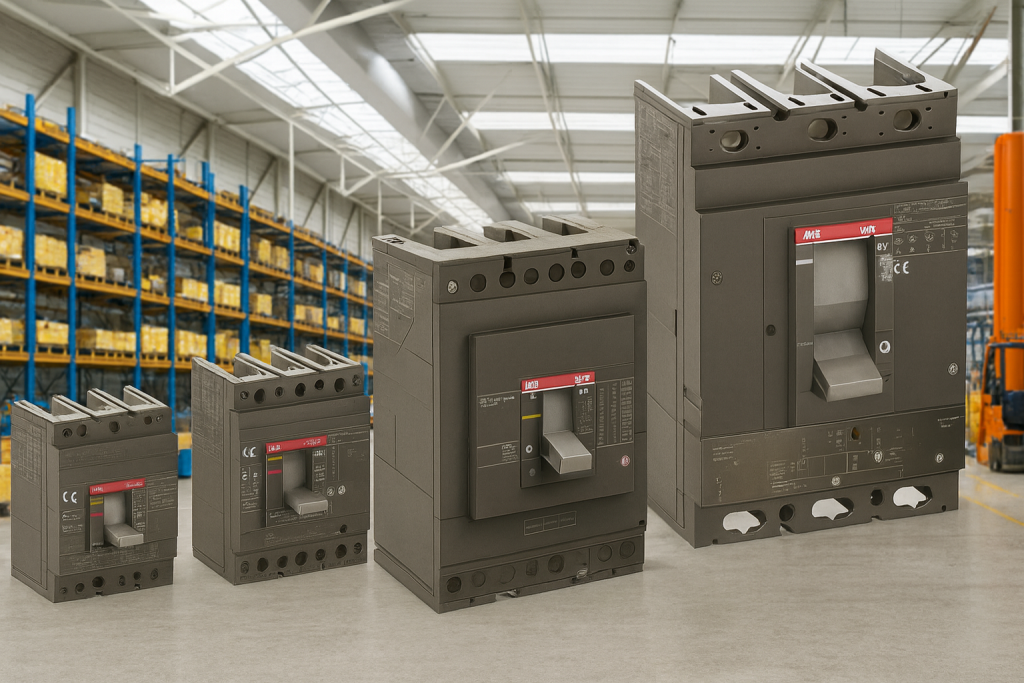
If you’re developing or upgrading an electrical system, you’ve likely come across various ABB breaker families. Two of the most common circuit breakers are ABB SACE FORMULA and ABB Tmax. ABB Tmax breakers are known for complex electronic trip units and configuration possibilities.
ABB SACE FORMULA molded-case circuit breakers take a simplistic approach without losing safety, dependability, or performance. This post covers the ABB FORMULA breaker family, so you can quickly grasp where it fits, what problems it solves, and whether it’s right for your next installation.
Dependable Circuit Protection
Why SACE FORMULA Molded-Case Breakers for Power Distribution?
When you need dependable ABB breaker power protection without engineering complexity or costly add-ons, ABB SACE FORMULA molded-case breakers are a great choice. They’re engineered around one core idea: Give contractors and end-users essential circuit protection features in a compact, easy-to-order platform — without configuration headaches.
Unlike breaker lines that need multiple accessory decisions, an ABB FORMULA breaker gives you fixed thermal-magnetic protection — the standard and proven combination of thermal sensing for overloads and magnetic sensing for short-circuits built in. That means less guessing, fewer adjustments, and faster commissioning.
“
Give contractors and end-users essential circuit protection features in a compact, easy-to-order platform — without configuration headaches.
”
European and North American Frame Sizing
Understanding the SACE FORMULA Breaker Family
The beauty of the SACE FORMULA lineup is there aren’t dozens of versions to sort through. Instead, ABB simplifies the range into a limited number of frames. Each ABB FORMULA breaker frame is sized for different current levels and electrical environments.
✔ IEC FORMULA Breakers — Up to 630A The IEC range (used in most of the world outside the U.S.) includes four frame sizes: A0, A1, A2, and A3, all the way to 630 amperes. IEC stands for the International Electrotechnical Commission. The Commission defines global standards for electrical safety.
✔ UL/CSA FORMULA Breakers — Up to 250A North America uses UL/CSA standards. UL (Underwriters Laboratories) and CSA (Canadian Standards Association) certify products for safety and performance in U.S. and Canadian markets. In this case, the FORMULA line is just two frames — A1 and A2 — covering 100A and 250A ratings.
Although the two versions serve different regions, they share FORMULA DNA: simplicity, compact size, and fixed trip protection. That’s why you can consider these breakers as one family,sized for their markets.
Comparing Frame Sizes
Specifications and Frame Sizes Explained
Region
Frames
Max Rating
Typical Use
IEC
A0, A1, A2, A3
Up to 630A
Globally standardized industrial and commercial panels
UL/CSA
A1, A2
100A to 250A
North American panels, OEM equipment, and facility retrofits
All FORMULA breakers are:
Fixed-mounted, meaning they’re installed directly onto a panel, not racked in and out
Equipped with front terminals, simplifying wiring
Built with double insulation and positive operation mechanisms giving you safe and predictable switching
Reverse feedable, meaning line and load connections can be swapped without derating
ABB Formula A1 and A2
Thermal-Magnetic Trip Units for Protection
Many users prefer breakers with minimal adjustment points because mistakes in settingscan cause nuisance trips or failed protection during a fault.
ABB FORMULA solves this with fixed thermal-magnetic trip units. The ABB FORMULA breaker thermal element handles long-duration overloads, while the magnetic element trips instantly under disruptive short circuits.
No configuration. No toggling curves. No deciphering manufacturer settings… You install it, and it works.
Matching Loads and Meeting Standards
Low-Voltage Breakers for Industrial Panels
If you’re building or upgrading:
HVAC equipment Commercial distribution boards OEM factory panels Pump or motor circuits Small industrial switchboards
You don’t always need a programmable breaker with advanced logic. You just need something that:
✔ Fits the space ✔ Matches the load ✔ Breaks safely ✔ Meets standards
That’s where the ABB FORMULA breaker family stands out. Its reduced depth design (as little as 2.36 inches in UL versions) makes it perfect for compact enclosures where space is at a premium. The IEC frames also maintain compact forms, reducing the space required inside a switchboard.
ABB FORMULA vs. Tmax Breakers
How FORMULA Differs from ABB Tmax
How ABB SACE FORMULA Differs from ABB Tmax
Feature
FORMULA
Tmax
Trip Units
Fixed thermal-magnetic
Adjustable, electronic
Target User
Contractors installing standard power circuits
Engineers specifying high-performance or complex loads
Configuration
Minimal options
Many options
Cost
Lower
Higher
Current Range
Up to 630A
Up to 1600A+ depending on model
If you’re tired of comparing trip curves, deciphering breaker families, or explaining pricing to customers who don’t need advanced features, you’ll appreciate this product line. ABB FORMULA breakers give you:
The right ratings
The right sizes
The right approvals
And the right price point
No more being forced into design decisions you didn’t ask for. Whether you’re installing a small commercial branch panel or a medium-sized industrial load center, ABB FORMULA gives you a professional solution that keeps power flowing and your work productive.
FAQ
Are ABB SACE FORMULA breakers suitable for industrial loads?
Yes. They offer fixed thermal-magnetic protection ideal for common industrial and commercial circuits.
Do I need tools to adjust their protection settings?
No. FORMULA trip units are locked at tested thresholds to prevent misconfiguration.
Can I reverse-feed these breakers?
Yes — both ranges can be reverse-fed without derating
Why are there different versions for IEC and UL/CSA?
Different regions adopt different safety standards. ABB designs breakers that fully comply with each market’s requirements.
What is “fixed mounting”?
It means the breaker bolts directly into the panel; it’s not removable like drawout gear.
Do these breakers support accessories?
Yes, FORMULA offers optional additions like shunt trips and auxiliary contacts.
What does “positive operation” mean?
It guarantees that the controller position matches the contact position, improving operator safety.
Glossary of Technical Terms
1. Molded‑Case Circuit Breaker (MCCB) A type of circuit breaker housed in a durable molded plastic case. It protects electrical circuits from too much current, which can cause damage, overheating, or fire.
2. Thermal‑Magnetic Trip Unit The built‑in mechanism inside many breakers (including FORMULA) that detects problems.
Thermal part trips when current stays too high for too long
Magnetic part trips instantly during a short circuit
3. Frame Size (A0, A1, A2, A3) The physical and electrical capacity category of a circuit breaker. Larger frames handle higher currents and fault levels but are still part of the same product family.
4. UL / CSA Regional safety standards:
UL (Underwriters Laboratories) certifies products in the United States
CSA (Canadian Standards Association) handles Canadian certification Breakers must pass strict tests before they can be used legally in North America.
5. IEC The International Electrotechnical Commission, an organization that creates global electrical standards used in most countries outside North America. IEC‑rated devices follow different testing rules than UL/CSA ones.
6. Short‑Circuit Breaking Capacity The maximum amount of fault current a breaker can safely interrupt without failing. Higher numbers mean the breaker can handle more extreme electrical faults.
7. Reverse Feedable A feature allowing a breaker to accept power from either the top or bottom terminals without losing its rating. This gives installers more flexibility when designing a panel.